Bitcoin to the Moon: Mining in Space
The Orbital Infrastructure Thesis

Cheap power has never been enough on its own for Bitcoin mining. Off-grid solar farms offer electricity at near-zero marginal cost, yet miners have largely avoided them due to low capacity factors. Without reliable uptime, the math doesn’t check out.
Space flips the script. In low Earth orbit (LEO), a solar array operates at close to 95% utilization. The question now turns to the capital cost of getting operations out there. A growing number of companies think it will pencil out.
TLDR
- Starcloud-1: launched November 2025 via SpaceX Falcon 9 rideshare, carrying the first H100 GPU in orbit.
- Starcloud-2: targets October 2026, carrying Bitcoin ASICs + Nvidia Blackwell, 100x the energy generation capacity of Starcloud-1. Positioned to become the first company to mine bitcoin in space.
- Physics case: Orbital power estimated at <$0.01/kWh; solar utilization 5–8x ground panels; passive radiative cooling into deep space eliminates fans, pumps, and water.
- Bitcoin's role: ASICs are the ideal bootstrap for orbital infrastructure — 30x cheaper per kW than GPUs, low latency requirements, and a permissionless 24/7 revenue stream.
- Big picture: Bitcoin mining could be an economic catalyst for funding orbital infrastructure. Monetizing solar panels in space may pay for the next generation of satellites, and potentially for other extraterrestrial applications beyond compute.
The Orbital Mining Thesis
Over the weekend of March 21–22, 2026 in Austin, Texas, Tesla CEO Elon Musk announced “the most epic chip building exercise in history by far.” Terafab — a joint venture between Tesla, SpaceX, and xAI — is a planned $20–25 billion semiconductor fab on the North Campus of Giga Texas, targeting 2-nanometer process technology and two classes of chips: edge-inference processors for Tesla’s Optimus robots and autonomous vehicles, and high-power chips hardened for space. The stated goal is more than one terawatt of AI compute per year, with Musk predicting that the vast majority of that capacity ends up in orbit.
Musk’s vision supports what startups like Starcloud, Intercosmic Energy, and Aetherflux have been arguing for years: terrestrial power constraints are real, orbital solar is structurally superior, and the infrastructure that runs the next era of AI compute will increasingly live above us. Notably, Nvidia CEO Jensen Huang arrived at a similar insight at GTC 2026 the same week: the competitive advantage in AI infrastructure belongs to whoever converts power into the highest-value token output at scale.
Earlier in March 2026, Starcloud CEO Philip Johnston posted on X: "Starcloud will be the first to mine Bitcoin in space." Starcloud-1 builds on a successful 2025 demonstration in which Nvidia H100 GPUs operated in Low Earth orbit (LEO), performing AI computing tasks, including running the first large language model (Google's Gemma) ever executed in orbit, and proving that compute hardware can function in space.
Starcloud-2 raises the stakes considerably. The satellite, scheduled for October 2026, will carry Bitcoin mining ASIC chips alongside several Nvidia H100 GPUs and the new Nvidia Blackwell platform, with 100x the energy generation capacity of Starcloud-1. The company has filed an application with the Federal Communications Commission (FCC) to deploy 88,000 solar-powered satellites for orbital data centers, with a long-term target of 5 GW of orbital capacity supported by solar and cooling panels approximately 4 kilometers wide and long.
Starcloud is not alone. Intercosmic Energy is pursuing orbital mining via CubeSat-class spacecraft in Highly Elliptical orbit (HEO), targeting approximately 23 hours of sunlight per day with lower radiation exposure than LEO. Aetherflux, originally a space-based solar power beaming startup, has pivoted toward orbital compute nodes. Terawatt Space, a California-based startup, is commercializing ultra-lightweight, radiation-hardened solar panels for satellite deployment at $11–15 per watt and as low as 73 grams per square meter, a fraction of legacy space solar panel weight.
The supply chain for orbital compute is forming around these ventures. However, there is a missing link.
The Problem: Space-Based Solar Power
For more than fifty years, space-based solar power (SBSP) has occupied a strange position: the physics work, the engineering is difficult but solvable, but the economics don’t check out. The fundamental problem is transmission. A solar array in geostationary orbit can receive much more energy per square meter than a terrestrial panel. But getting that energy back to Earth requires a lot: microwave or laser power beaming, large receiving arrays, atmospheric losses, safety concerns, and regulatory overhead. Every SBSP concept collapses on the same Achilles' heel: massive upfront capital before any revenue, uncertain payback, and an entire layer of hardware that must be built on the ground before the orbital infrastructure pays for itself.
A Solution: Bitcoin as Anchor Tenant
Orbital bitcoin mining fits this bill. Energy does not need to be transmitted if value can be created where the energy exists. Bitcoin mining converts energy at the source into SHA-256 hashrate, which is sold to the Bitcoin network (via mining pools) and rewarded with BTC. This positions mining as the initial load that can justify a project. Intercosmic Energy calls this “the lossless value pipeline” from space to Earth. Luxor’s Bitcoin Hashprice Index quantifies how much a miner can expect to earn from its hashrate production, and its Energy Hashprice metric expresses bitcoin mining revenue per watt-hour (Wh) of electricity used.
The Bitcoin bootstrap logic for orbital compute mirrors what is already playing out on Earth. Bitcoin mining provides the baseload revenue that justifies capital investment, absorbs idle capacity as a virtual power plant, and creates the economics that let more complex GPU workloads become viable tenants alongside it. In space, the same dynamic scales up. ASICs can be dynamically throttled through custom firmware, redirecting solar power to GPU compute when higher-priority AI inference jobs arrive, and then returning to mining when demand clears. The Bitcoin network buys every watt the solar arrays produce in between, significantly improving project economics.
The deeper implication is what this pattern enables over time. Bitcoin mining operations fund satellite maintenance and upgrades. Upgraded satellites generate more power. More power funds more constellations. Lower unit costs make the next deployment cheaper. Each iteration makes the next generation of space infrastructure more viable: asteroid mining, permanent lunar presence, deep-space exploration. The economics of space infrastructure is on the cusp of a positive feedback loop, and bitcoin mining may be the ignition sequence. As Musk articulated: “from a terawatt of orbital compute, to a petawatt via lunar mass drivers, to a millionth of the sun’s energy”.
Why Space? Pros of Orbital Mining
Starcloud CEO Johnston's rationale for why Bitcoin mining belongs in orbit starts with unit economics on hardware:
"GPUs are about 30 times more expensive per kilowatt than ASICs. A 1-kilowatt B200 chip might cost $30,000. A 1-kilowatt ASIC is like $1,000." — Philip Johnston, CEO, Starcloud
Cheaper hardware per kilogram of launch mass means lower mission risk and faster payback. But the real structural advantage is on the energy side.
Solar Utilization
In LEO, solar panels face near-continuous exposure to unfiltered sunlight. This additional utilization is estimated at 5–8x the capacity factor of equivalent panels at mid-latitudes on Earth, where weather, atmospheric scattering, and the day/night cycle all reduce generation.
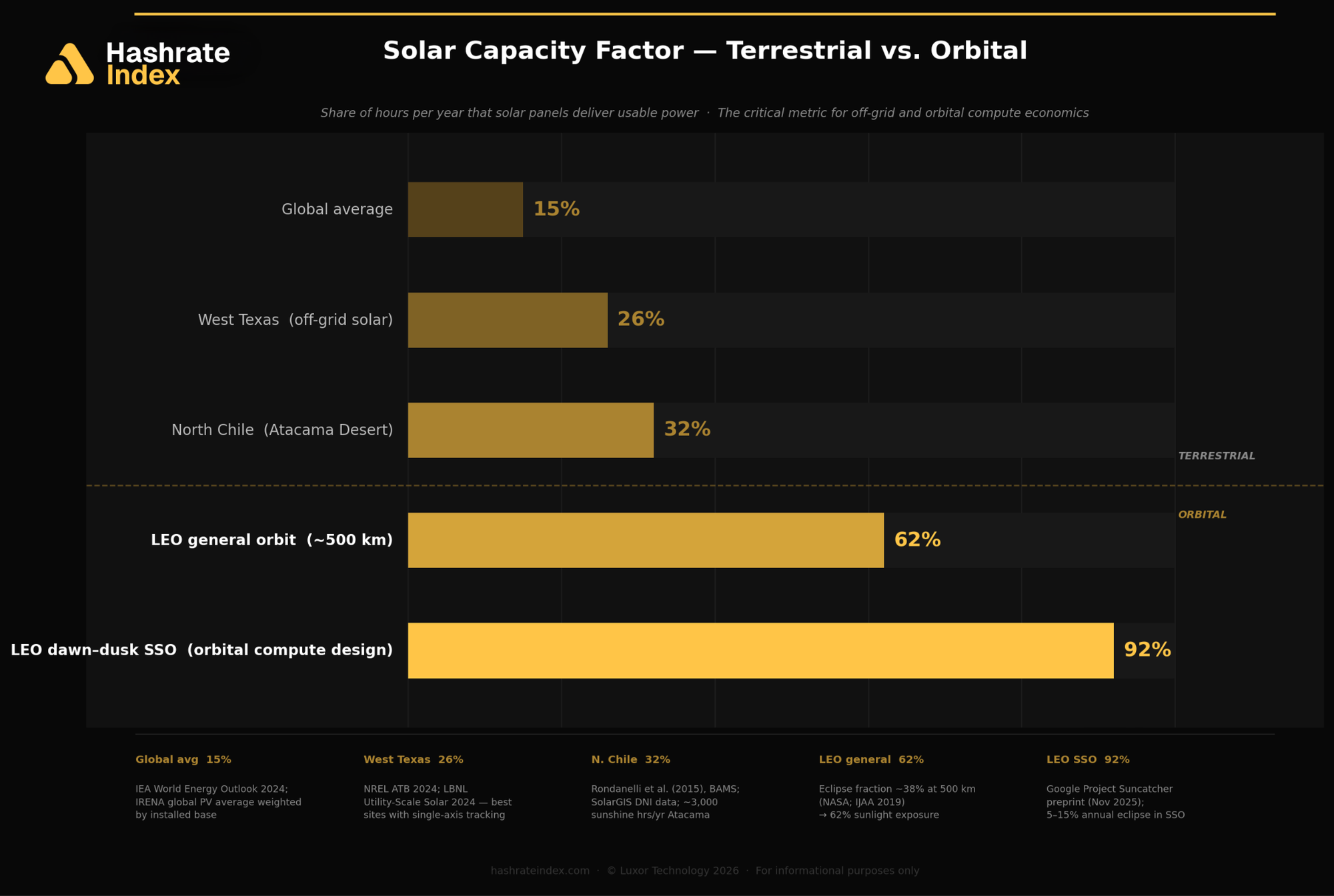
A solar farm in West Texas runs at roughly 25% capacity factor; northern Chile, one of the best solar regions on Earth, reaches 30–33%. The global average is closer to 15–17%. In sun-synchronous LEO, a solar array operates at approximately 90–95% utilization, with near-continuous exposure to unfiltered sunlight and no atmospheric scattering. The practical implication: an orbital array produces 3–4x more energy per unit of installed capacity than the best terrestrial solar sites, simply because the panels are almost never idle. This structural difference produces all-in power cost models below $0.01/kWh, compared to an average industrial power cost of $0.05/kWh for terrestrial miners.
Jensen Huang had this take at GTC 2026: AI factories are token production systems, and tokens per watt is the metric that matters. As demand for inference compounds and power becomes the binding constraint on compute capacity growth, the case for off-planet infrastructure strengthens.
Passive (Radiative) Cooling
Cooling chips is one of the most expensive problems in terrestrial mining. A large mining facility may pump millions of gallons of water through cooling loops and run enormous fan arrays just to keep ASICs from overheating. How would cooling work in space?
The answer is radiation. Every object above absolute zero (0 Kelvin) emits heat as infrared light. In a vacuum of space, with no air to conduct heat away, radiation into deep space (~2.7 Kelvin) is the only mechanism available. A well-designed radiator panel can shed substantial heat passively, with no fans, pumps or water. This is another core advantage of orbital compute.
Still, thermal management in space is genuinely difficult. The challenge is transferring heat efficiently from the chip to the radiator without air. In a vacuum, conduction is the only path: heat must travel through thermal interface materials (heat pipes and structural pathways) before it can radiate away as infrared light. This “conductance chain” must handle conditions that vary dramatically by orbital phase. Temperature swings between sunlit and shadowed passes can exceed 150°C (302°F) within a single 90-minute orbit, cycling thousands of times per year. Radiator panels must be sized for worst-case heat loads, and those panels add mass with opportunity cost (every kilogram of radiator is a kilogram not carrying revenue-generating compute). Musk noted at the Terafab event that chips optimized for space should “generally run a little hotter than you would on Earth to minimize radiator mass”, highlighting thermal efficiency in space chip design.
This is where firmware-level optimization may become critical. Luxor’s custom Antminer firmware (LuxOS) has an Advanced Thermal Management (ATM) feature which dynamically adjusts chip frequency and voltage in real-time to maintain thermal thresholds for sustainable ASIC operations. On Earth, ATM helps operators maximize efficiency and avoid overheating events. In orbit, where no technician can reach, firmware-level thermal management is likely to be a primary candidate for extending hardware lifespan over multi-year missions. A satellite ASIC that runs 5°C hotter than it should may last two-three years instead of four-five.
Back Down to Earth: Cons to Consider
Hardware and Infrastructure Redesign for Space
Commercial off-the-shelf mining hardware is not designed for the orbital environment. Radiation causes cumulative damage to silicon. Orbital compute deployment requires systematic radiation qualification for each hardware generation, adding cost and development time that has no terrestrial equivalent. Musk acknowledged this at Terafab, noting that space chips must account for “high energy ions, photons, and electron buildup”, a fundamentally different environment from ground-based compute. Starcloud subjected its H100 GPUs to particle accelerator testing to identify radiation failure thresholds before launch.
Beyond radiation, the mechanical and operational environment changes everything. Conventional airflow cooling and standard rack-mounting assumptions are eliminated. There is no field servicing: hardware that fails in orbit stays failed for the satellite’s operational life. Satellites must carry propellant budgets for end-of-life deorbit maneuvers, adding mass and cost. Orbital debris is a growing risk, and the probability compounds as constellation density (i.e., competition) increases. The hardware supply chain itself must be redesigned: components must be screened for radiation tolerance, assembly must occur in cleanroom conditions, and thermal interfaces must be engineered for space vacuum. The difference between a terrestrial ASIC deployment versus a space-ready project is likely years of qualification work and millions in additional engineering cost. These are solvable problems, but they are not trivial.
Launch Costs
Getting hardware to orbit today costs approximately $1,500–$3,000 per kilogram on current SpaceX vehicles. The economics of orbital compute make sense only when those costs fall to roughly $200–$500 per kilogram.
To show the math, the comparison needs an explicit mass assumption. A fleet of Antminer S21 XP units (270 TH/s each, 18.7 kg each) requires approximately 3,700 units per EH/s, or about 69 metric tons of bare hardware. The denser hydro-cooled S21 XP Hyd (473 TH/s, 12.8 kg) cuts that to roughly 27 metric tons. An orbital deployment also requires satellite bus, radiators, solar arrays, and communications equipment, which typically adds another 1.5–3x the payload hardware mass. Working from a mid-range assumption of ~50 metric tons of bare ASIC hardware and total orbital system mass of ~100 metric tons per EH/s: deploying 1 EH/s of Bitcoin mining hardware on Earth could cost roughly $40–$65 million all-in (hardware plus infrastructure). At today’s launch cost of $1,500–$3,000/kg, the full orbital system launch premium runs approximately $150–$300 million before satellite engineering costs, a 2–7.5x CapEx premium over terrestrial deployment (depending on hardware model, launch vehicle, and orbital system mass).
On the other side of the coin, launch cost efficiency over time has shown promise. Space launch costs peaked near $80,000/kg during the Shuttle era (1981–2011), have fallen roughly 50-fold to ~$1,500/kg today through reusability (2015–present), and are projected to reach ~$15/kg under a fully reusable Starship regime (2027–2030s).
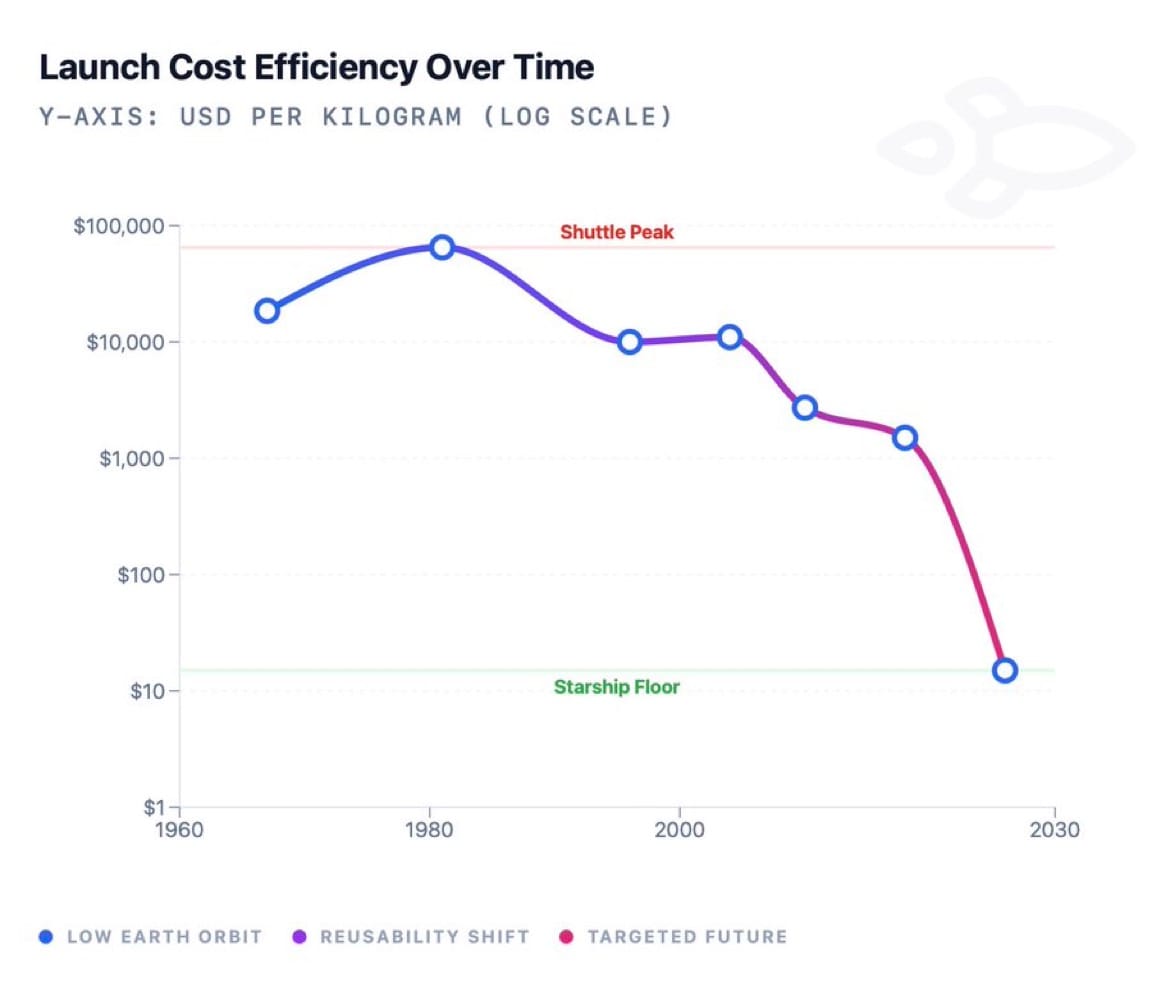
At $500/kg under an aggressive Starship reuse scenario, the bare ASIC hardware launch cost drops to $14–$35M, approaching terrestrial hardware cost itself. Including orbital system overhead, the all-in premium compresses to roughly 1–3x. At $200/kg — the threshold that Google’s Project Suncatcher concludes may be reachable by the mid-2030s under sustained Starship learning-curve assumptions — the amortized launched power price becomes roughly comparable to what terrestrial data center operators spend on energy per kilowatt-year. Notably, this is an energy-cost comparison, not a total CapEx equivalence; engineering, qualification, and satellite integration costs remain substantially higher in orbit even at $200/kg. Still, at that threshold, near-zero OpEx from free solar power and passive cooling can tip the lifetime return profile decisively toward orbit. The math can check out, but only at a launch cost not yet demonstrated at commercial scale.
This trajectory depends almost entirely on SpaceX’s Starship program. The current Starship (Block 2) is projected to deliver approximately 100 metric tons to LEO in a fully reusable configuration; Version 3, under development, targets up to 200 metric tons fully reusable — roughly 9x the reusable payload capacity of a Falcon 9. The “Pez dispenser” payload mechanism standardizes satellite form factors into a vertical internal rack and ejects them sequentially, improving per-unit deployment cost significantly.
Network Latency: Manageable But Worth Monitoring
Bitcoin mining requires very little bandwidth since nodes only need to transmit block headers and proof-of-work solutions, but latency still matters. At Luxor Pool, we observe that miners connecting to our nodes from locations with 100+ millisecond (ms) ping times may see approximately 0.1% rejected share rates attributable to latency. This is a manageable overhead, but it is not zero. LEO-to-ground latency typically runs 10–50ms, which is competitive with or better than long-haul terrestrial connections. On that basis, we would expect orbital mining operations to perform well on Luxor Pool, though we have not (yet) tested it directly.
New Complexity
Orbital compute deployments sidestep many constraints that slow terrestrial data centers: land acquisition, utility interconnection queues, local zoning. In that narrow sense, the path to deployment can be faster than breaking ground on Earth. However, orbital compute introduces its own regulatory layer. FCC spectrum licensing, frequency coordination with other operators, debris mitigation filings, and International Telecommunication Union (ITU) registration are all required before a commercial constellation can operate. Starcloud’s FCC filing for 88,000 satellites is already drawing challenges from Amazon and others. The regulatory environment for large constellations is actively contested, and complexity scales with deployment size. For a first-generation proof-of-concept satellite, the regulatory lift likely exceeds that of a modest terrestrial facility. The long-run advantage is real, but not immediate.
Thinking Bigly: Toward Kardashev Type I
This is where the discussion shifts from mining economics to civilizational trajectory, and it's worth taking seriously for a block or two.
The Kardashev scale classifies civilizations by energy use. A Type I civilization harnesses all energy reaching its home planet from its star.
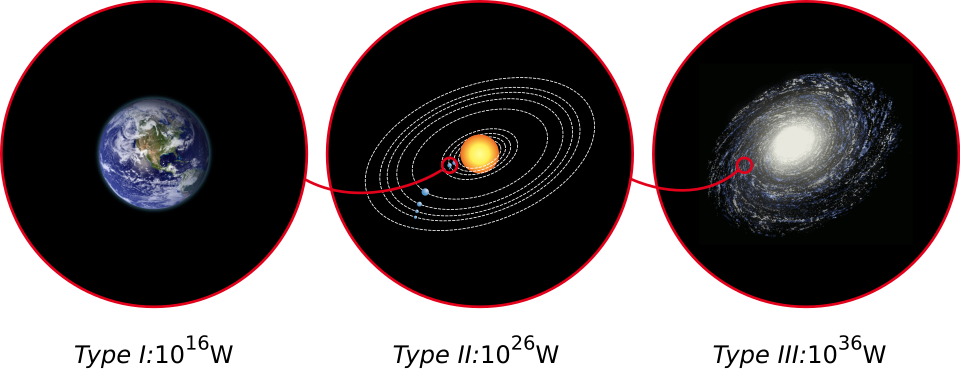
Earth currently sits at roughly Type 0.73. Type I requires capturing energy at planetary scale, which physically means capturing it in space before it's scattered by the atmosphere, reflected by clouds, or lost to the diurnal cycle.
Three threads are converging that, taken together, point in the same direction.
The first is artificial intelligence. AI represents the most energy-intensive cognitive technology humanity has ever built. Training frontier models already requires gigawatts of sustained power. Inference, at a civilizational scale, will require more. The terrestrial grid cannot absorb this demand without fundamental restructuring, and even if it could, land, water, and carbon create limits. Intelligence at scale demands energy abundance. It cannot outgrow its power supply.
The second is energy abundance. The Sun delivers approximately 1.74 x 10¹⁷ watts to the inner solar system. Earth's surface intercepts a tiny fraction of that, losing much of it to weather, atmosphere, and night. Energy as a resource itself is not scarce, our ability to harness it is. Building that infrastructure requires capital, routine launch cadence, and investment returns. This is what Bitcoin mining provides: a permissionless buyer of first and last resort for every watt of orbital solar energy. Bitcoin is an appropriate economic incentive for orbital energy capture.
Orbital compute doesn't necessarily start as a Kardashev project, but the infrastructure it requires — scalable solar arrays deployed in orbit, passively cooled, monetized by compute — sounds similar to the early elements of a Dyson swarm. Every compute satellite launched is another potential panel in an eventual planetary-scale energy capture system.

The Bitcoin network currently consumes approximately 210 TWh per year, under 1% of global electricity consumption. If Johnston is right that mining gravitates to orbit over time, it pulls capital toward routine launches. This should drive down the cost of access to space for every subsequent application.
What to Watch
The Starcloud-2 launch in October 2026 will be the proof-of-concept that matters. If ASICs run reliably in LEO (radiation, thermal management etc.), the economics become demonstrable rather than theoretical. Starship V3's launch cadence is the other variable. Whether SpaceX can hit the operating rate needed to drive per-kilogram costs into the $200–$500 range within this decade is uncertain.
The hashprice environment matters too. Fleets in orbit face the same margin structure as miners on the ground. As halving cycles continue to cut block subsidies, the operational cost advantage of sub-$0.01/kWh power becomes evermore significant. Operators who continue to chase the cheapest electrons stand to win.
If you’d like to learn more about Luxor’s full-stack Bitcoin mining services, please reach out to [email protected] or visit https://luxor.tech.
About Luxor Technology Corporation
Luxor delivers hardware, software, and financial services that power the global compute and energy industry. Its product suite spans Bitcoin Mining Pools, ASIC Firmware, Hardware trading, Hashrate Derivatives, Energy services, and a bitcoin mining data platform, Hashrate Index.
Disclaimer
This content is for informational purposes only, you should not construe any such information or other material as legal, investment, financial, or other advice. Nothing contained in our content constitutes a solicitation, recommendation, endorsement, or offer by Luxor or any of Luxor’s employees to buy or sell any derivatives or other financial instruments in this or in any other jurisdiction in which such solicitation or offer would be unlawful under the derivatives laws of such jurisdiction.
There are risks associated with trading derivatives. Trading in derivatives involves risk of loss, loss of principal is possible.

Hashrate Index Newsletter
Join the newsletter to receive the latest updates in your inbox.