Luxor Hashrate Lookback Series — October 2026
Luxor's Monthly Lookback Series is a deep dive into Bitcoin hashrate market activity. In this post, we cover October 2026's hashrate market and hashprice trends, forward market participation, trading activity and contract performance.




Luxor’s Monthly Lookback Series is a deep dive into Bitcoin hashrate market activity. In this post, we cover October 2026’s hashrate market and hashprice trends, forward market participation, trading activity and contract performance.
Summary
- Hashrate Up, Hashprice Down: USD hashprice fell 17.9% from open to close ($40.15 to $32.98 per PH/s/day) and finished October on its low. Difficulty rose 11.76% across the month (132.76T to 148.36T), the largest monthly gain since February 2024.
- Texas Machines Turned Back On: ERCOT's 4CP season closed on September 30. The 7-day network hashrate average rose 9.4% between September 30 and October 31 (976 to 1,067 EH/s). The two difficulty retargets it caused (+5.92% on October 16, +5.54% on October 29) were the first back-to-back pair above 5% since February 2024.
- Bitcoin Gave Back September: Bitcoin fell 8.0% from open to close ($84,049 to $77,332), with the low of $77,316 on October 30. The FOMC held its policy interest rate at 3.75–4.00% on October 28 (10–2 vote). Spot ETFs ended the month with $515M in net outflows, their first negative month since June.
- September's Hashrate Sellers Beat Spot: The October USD contract settled at $37.97 per PH/s/day. September's one-month sale ($38.51) beat it by 1.4%, and in BTC terms the two- and three-month sales beat the 0.00046 BTC settlement by 3–7%. The four earlier USD sales (May–August) lost 10% to 23%.
- The Forward Curve Prices a Pause, Not More Growth: USD forwards for November 2026 – March 2027 fell 12–16% between October 5 and November 2 (spot fell 19%), leaving the curve flat at $32–34 per PH/s/day. The November contract implies a difficulty of 146.18T, 1.5% below the spot reading in that snapshot: the curve expects October's surge to hold, not to extend.
October 2026 Spot Hashprice & Its Constituents
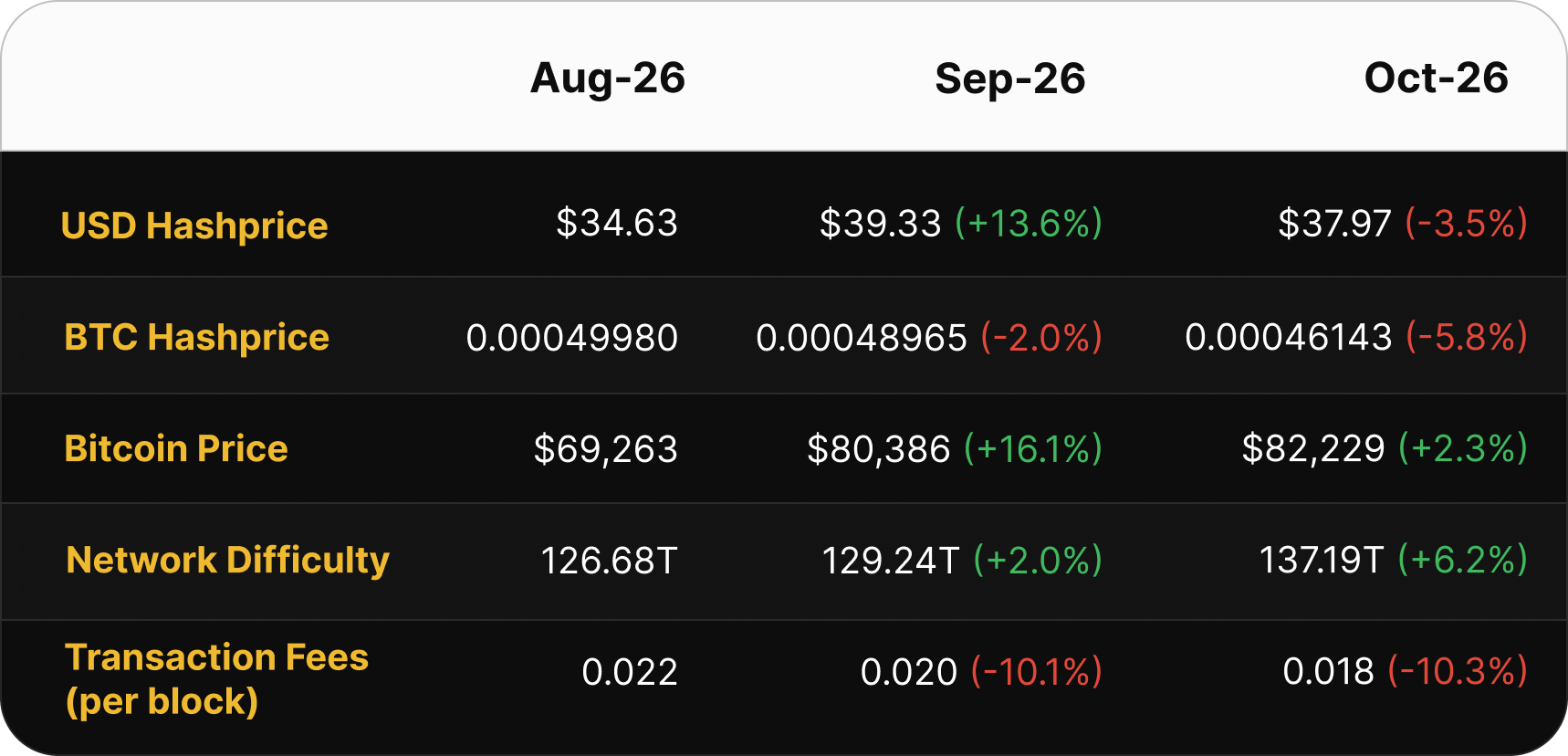
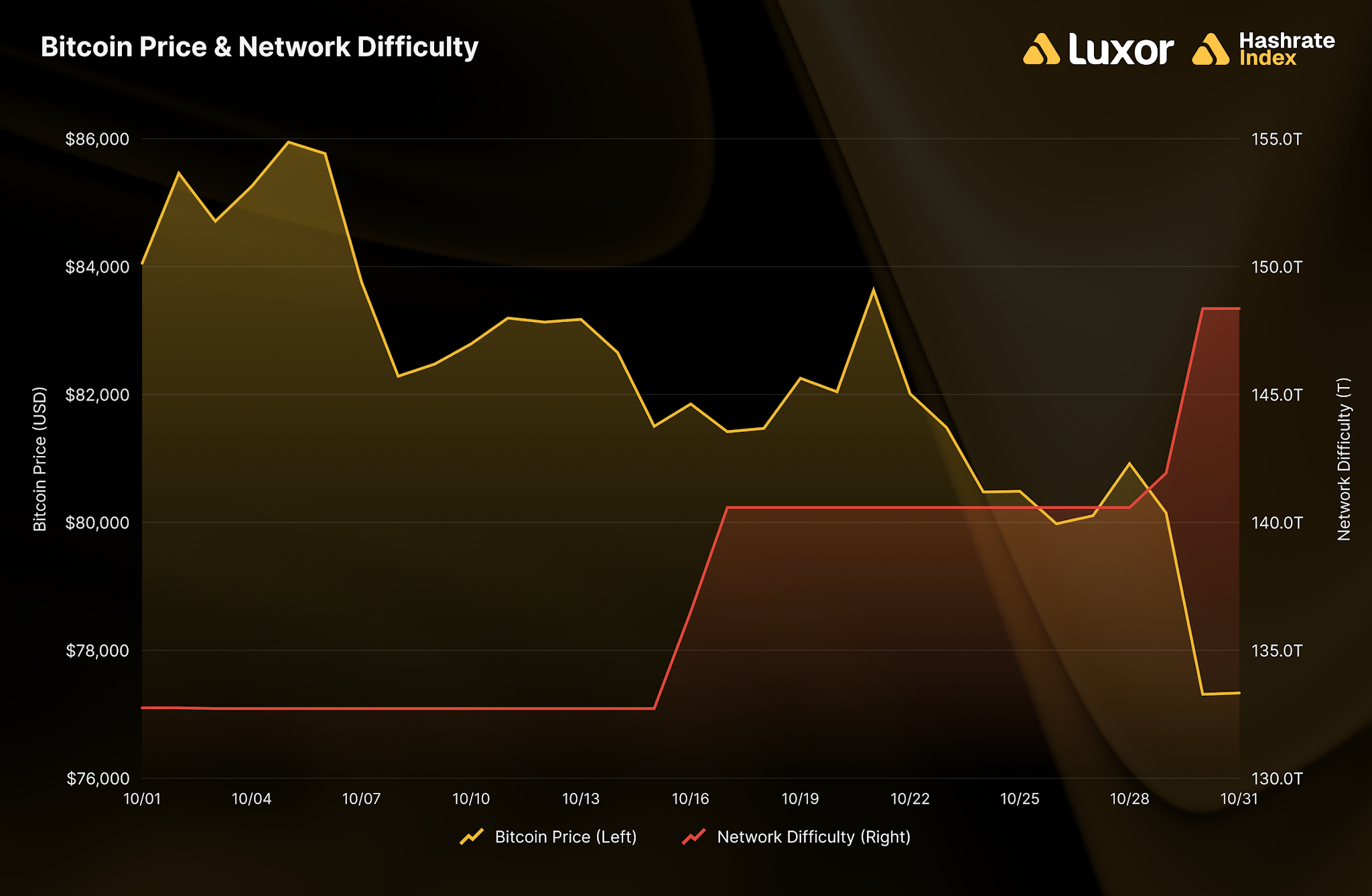
September closed on a question: would Bitcoin keep climbing, or would network difficulty take the hashprice gain back? October answered both with downside. Bitcoin fell 8.0% from open to close and difficulty rose 11.76% across two retargets. Hashprice lost $7.17, the largest open-to-close dollar decline since February 2025. On a monthly-average basis the move reads milder, $37.97 against $39.33 (−3.5%), because the damage was concentrated in the final two weeks.
USD Hashprice — Closed on the Low
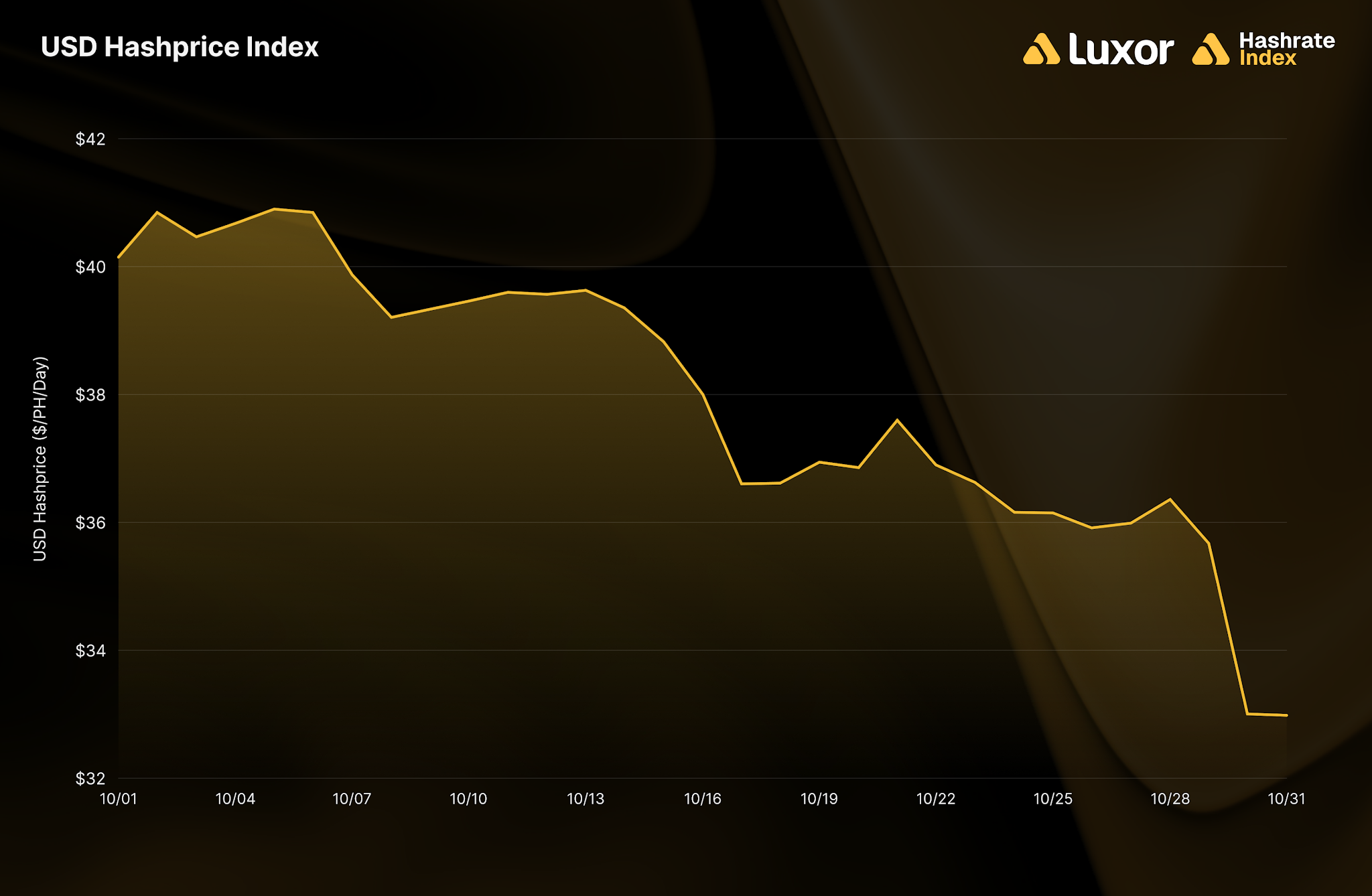
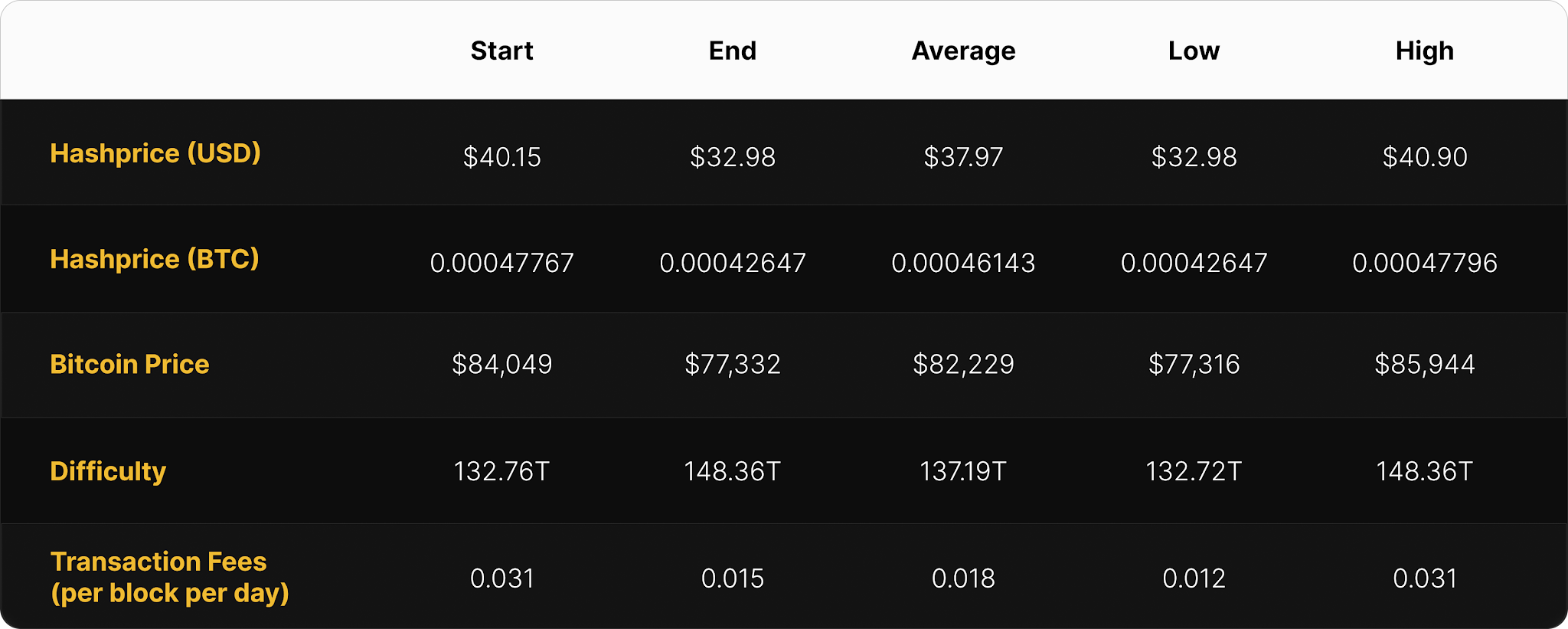
Hashprice opened October at $40.15 per PH/s/day, printed its high of $40.90 on October 5, and closed at $32.98 (−17.9%), the month's low. The monthly average of $37.97 was down 3.5% from September.
The decline came in two steps, each on a difficulty retarget: $38.83 to $36.60 across October 15–17, and $35.67 to $33.01 across October 29–30, when the second retarget and a 3.5% drop in Bitcoin landed on the same day.
BTC Price — Gave Back September's Gain
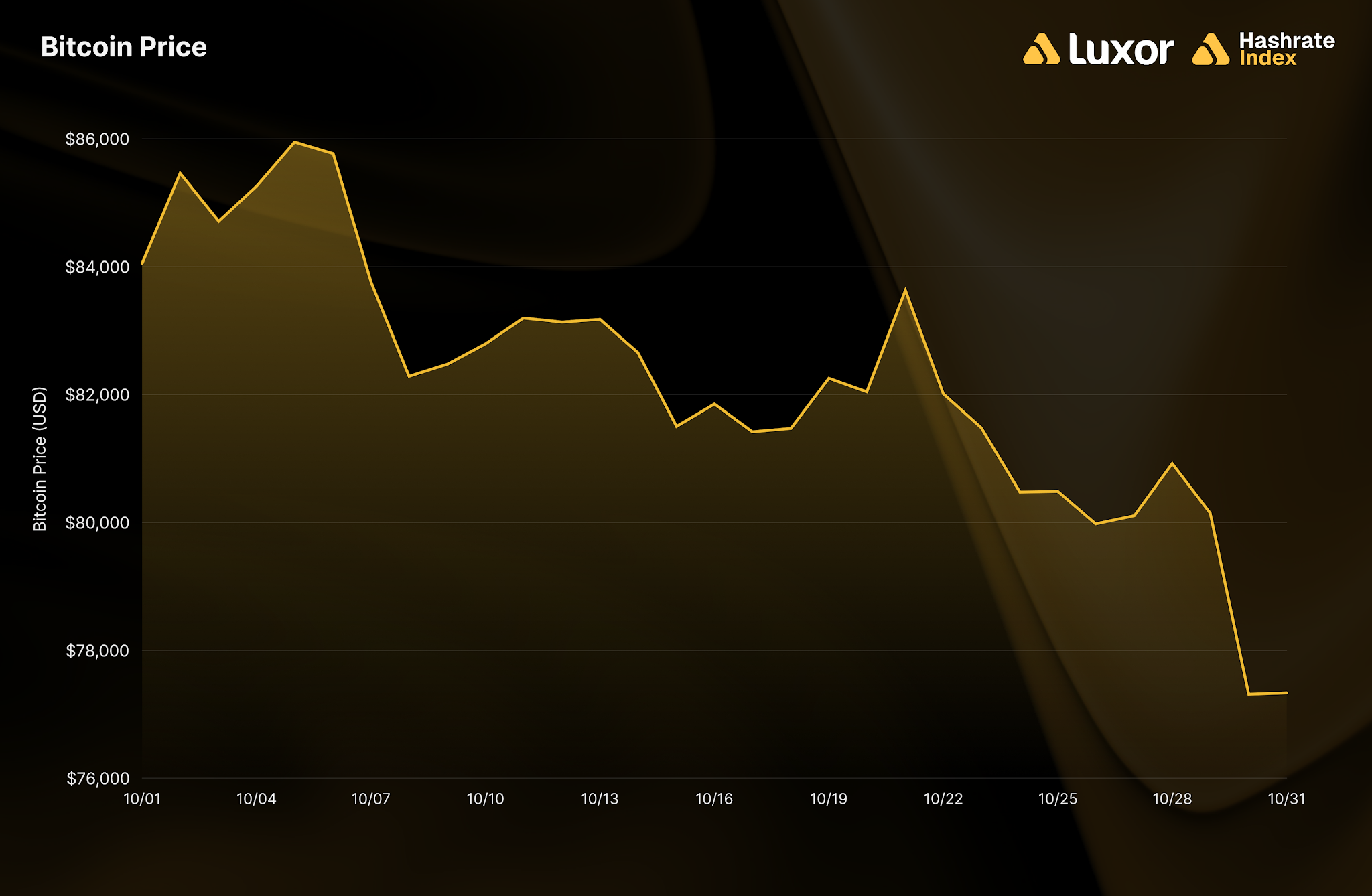
Bitcoin opened October at $84,049 and closed at $77,332 (−8.0%). The monthly average of $82,229 was 2.3% above September's, because the first three weeks held above $81,000; the high was $85,944 on October 5.
The event calendar was light. On October 28 the FOMC held the funds rate at 3.75–4.00% in a 10–2 vote, with two members preferring a hike; the next decision, with new projections, is December 9. Bitcoin's low of $77,316 came two days later, on October 30, down 3.5% on the day.
Spot ETFs were net sellers for the first time since June: −$515M for October, after +$2.65B in September and +$3.53B in August. The month stood at +$129M through October 29; a $643M outflow on October 30, the largest single day since June 25, flipped it. Year-to-date net flows fell to +$0.46B from +$0.97B at the end of September.
At $77,332, Bitcoin ended October 37.9% below its October 6, 2025 peak of $124,485 (−32.8% at the end of September). It also sits 19.7% below the 2026 high of $96,278 (January 15).
Network Difficulty — Two Upward Retargets Above 5%
Difficulty averaged 137.19T (+6.2%) and finished the month at 148.36T. Three adjustments occurred: −0.03% on October 3, +5.92% on October 16 and +5.54% on October 29. The net gain of +11.76% is the largest monthly difficulty growth since February 2024 (+16.2%), and the October 16–29 pair is the first back-to-back set of retargets above 5% since February 2 and 15, 2024.
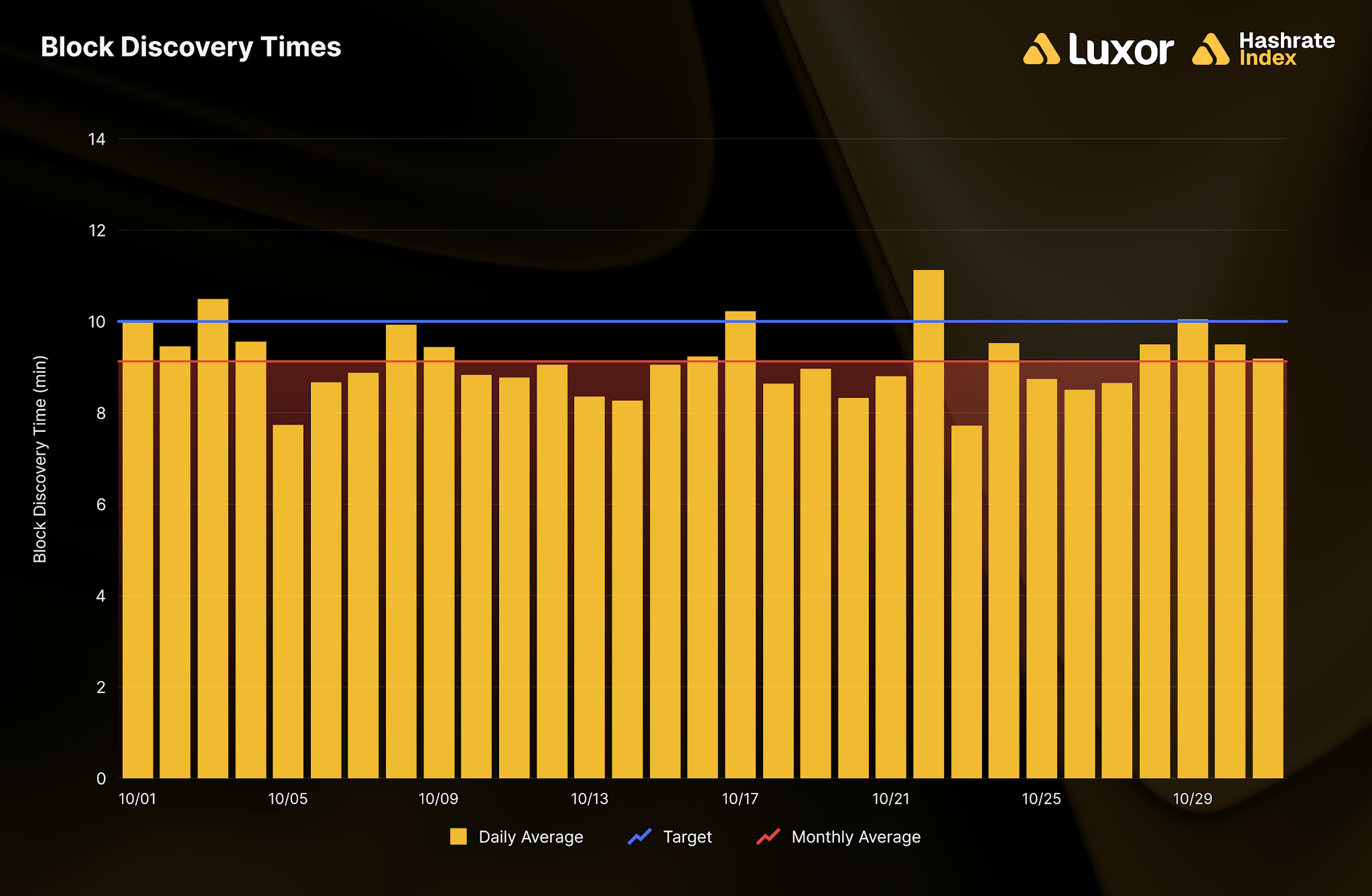
Block times averaged 9m08s, the fastest month since September 2025, with 27 of 31 days under the 10-minute target. The network is back above 1 ZH/s: the 7-day average crossed 1,000 EH/s on October 11 for the first time since June 1, and the October 16 epoch was the first above 139.70T, the 1 ZH/s equivalent, since March. The 7-day network hashrate average rose 9.4% from September 30 to October 31 (976 to 1,067 EH/s). That is 25.2% above the June 9 summer low (853 EH/s) and 7.7% below the October 18, 2025 all-time high (1,156 EH/s).
The hashrate came from Texas. ERCOT's 4CP season ended on September 30. The final coincident peak was set on September 12 (86.2 GW), below the season high of 90.8 GW on July 22. Flexible loads that curtailed through the summer had no peak left to avoid. Real-time power was cheap too: the LZ_WEST weekly average fell to $29/MWh in the week ending October 18 and $25/MWh in the week ending October 25, the lowest since mid-August. Both retargets above 5% fell inside that window. The monthly average tells a different story. October's LZ_WEST price averaged $43/MWh, the highest since January, lifted by October 5–8 and a $104/MWh day on October 31. The curtailment that ended was 4CP-driven, not price-driven.
Transaction Fees — Lowest Since April
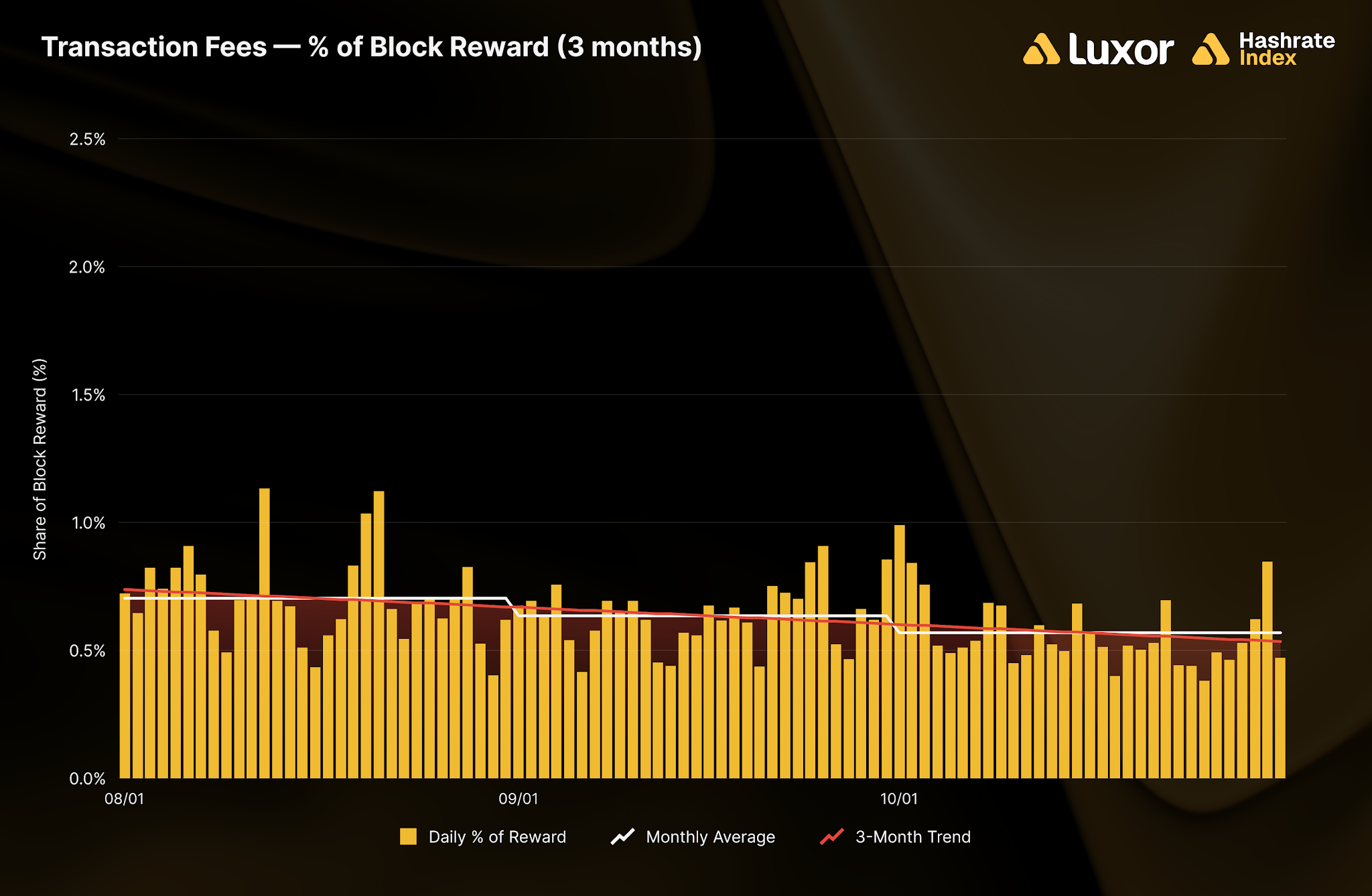
Average fee collection fell 10.3% to 0.0179 BTC per block, the lowest since April. Fees were 0.57% of total block rewards, a sixteenth consecutive month below 1%. Daily fee collection ran from 0.012 to 0.031 BTC per block, with the high on October 1.
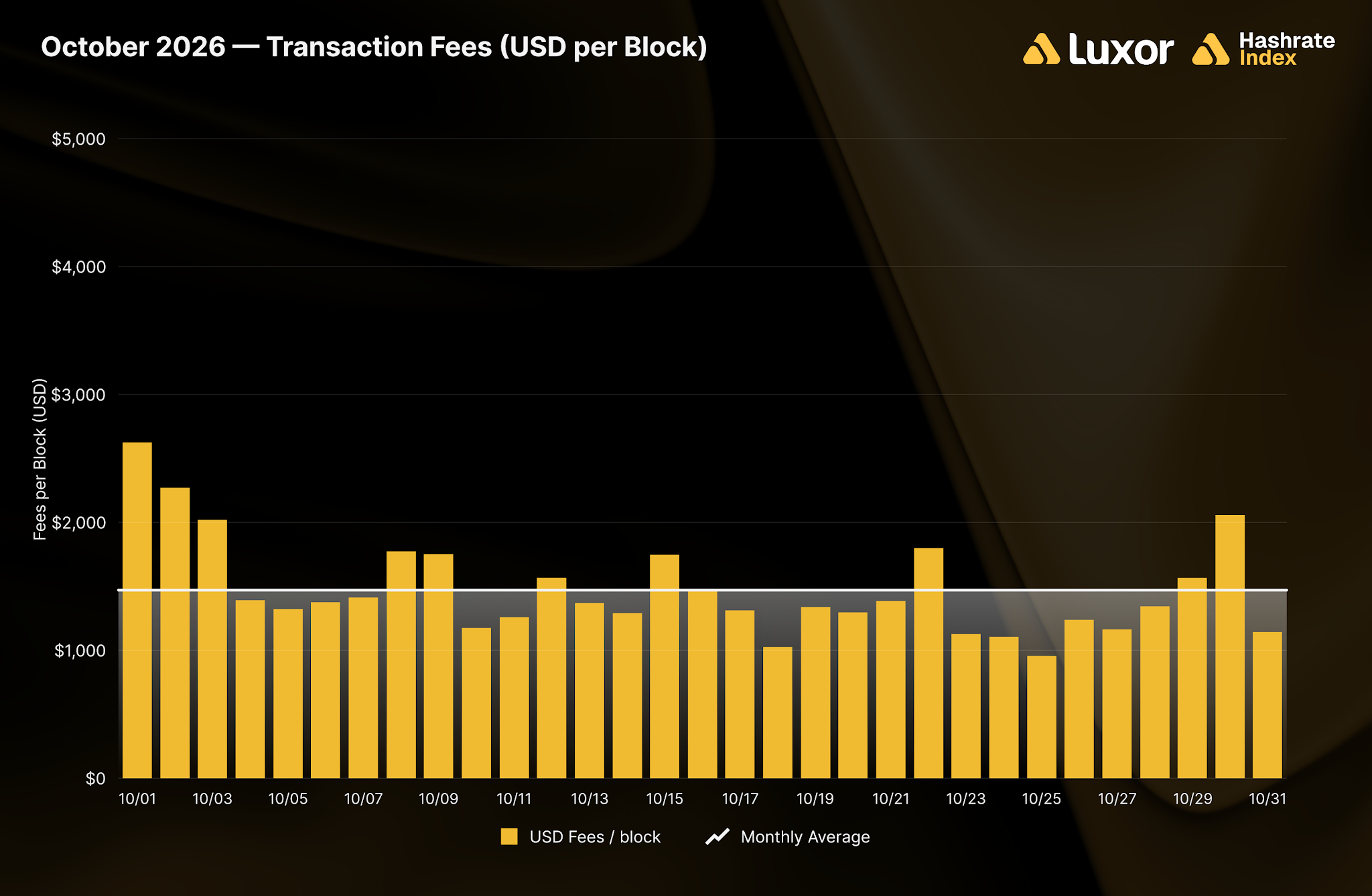
In USD terms, the average block earned ~$1,473 in fees (−8.3%), with both fees and Bitcoin's price falling.
BTC Hashprice — Difficulty Did the Work
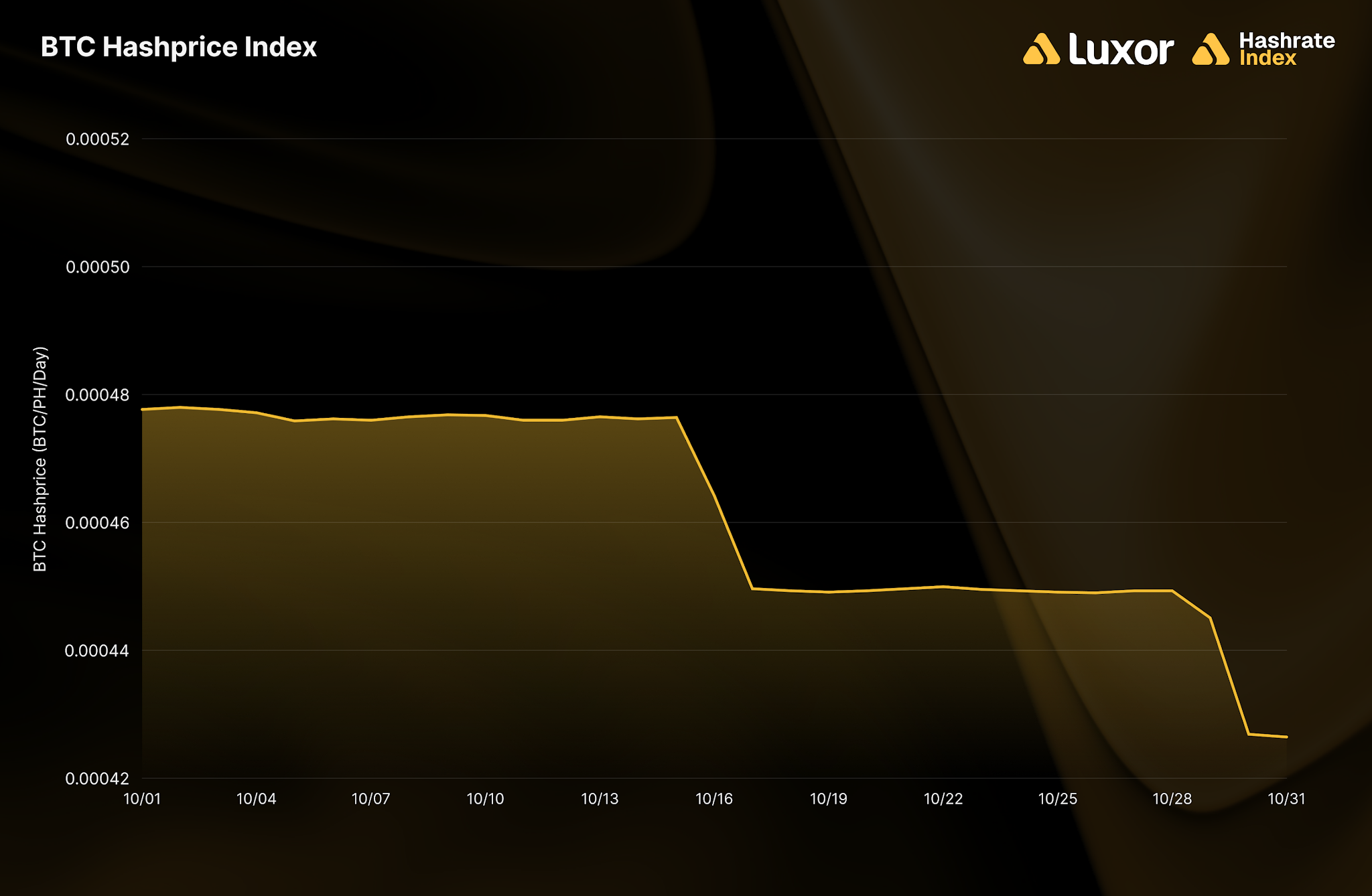
Monthly average BTC hashprice fell 5.8% to 0.00046143 BTC per PH/s/day, the lowest monthly average since April. The month opened at 0.00047767 BTC and closed at 0.00042647 BTC (−10.7%), the lowest month-end since November 2025, with both steps down landing on retarget days.
BTC hashprice is block rewards divided by difficulty, so Bitcoin's price does not enter it. October's three retargets compounded: −0.03%, then +5.92%, then +5.54%, for a net +11.76% . With rewards flat, 11.76% more difficulty alone cuts BTC hashprice by 10.5% . Lower fees account for the remaining ~0.2 points of the 10.7% drop.
Energy Hashprice — The Marginal Tier Crossed Under $48
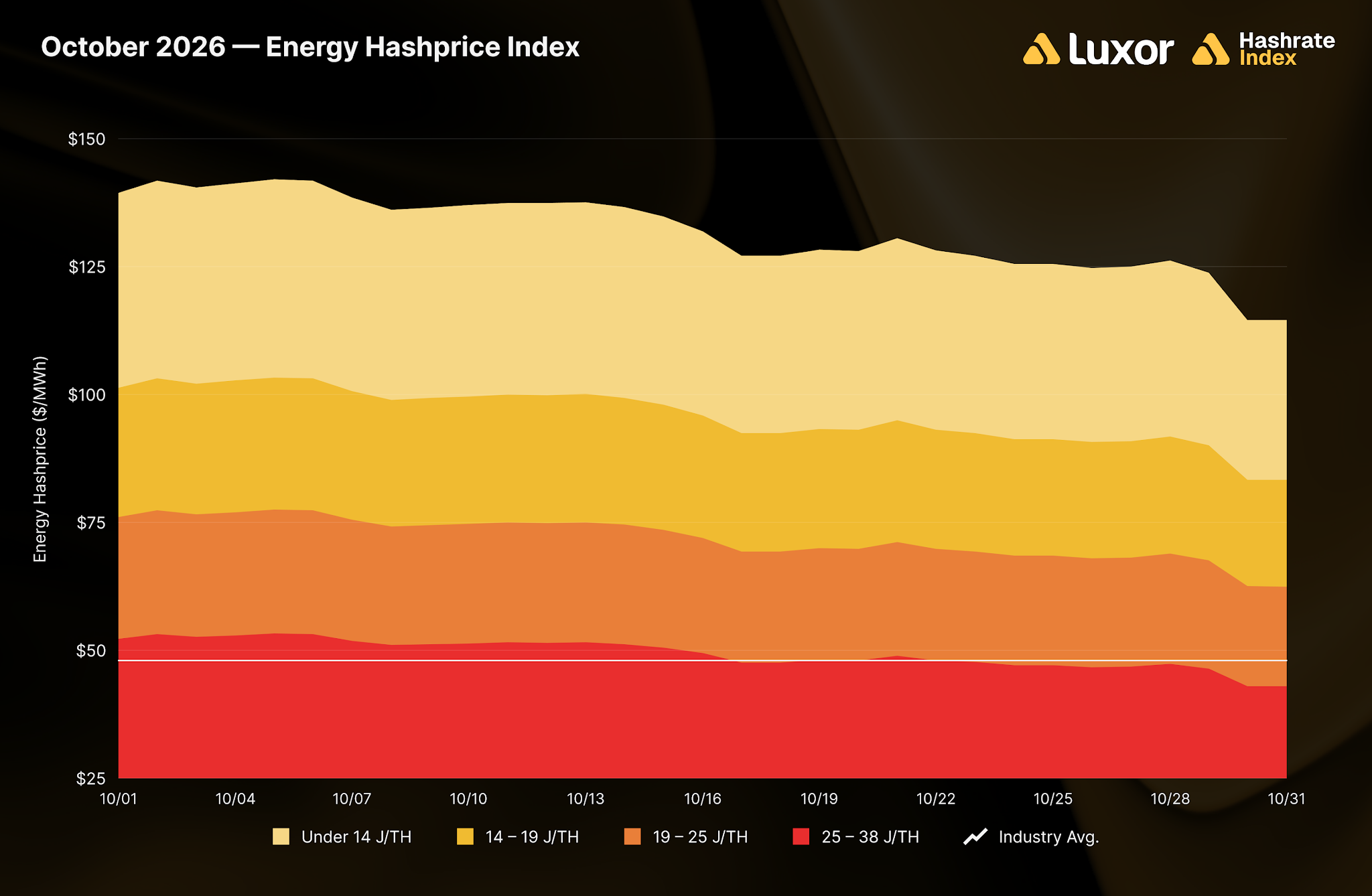
October lowered every fleet tier. Based on fleet efficiency, Energy hashprice averaged:
- ~$132/MWh for under 14 J/TH
- ~$96/MWh for 14–19 J/TH
- ~$72/MWh for 19–25 J/TH
- ~$49/MWh for 25–38 J/TH
Each tier's monthly average fell 3–4%, in step with average hashprice. Against an average industrial bitcoin mining power cost of $48/MWh, the 25–38 J/TH tier averaged $49/MWh for the month but finished at $43/MWh, below the line on each of the final nine days of October.
October 2026 Hashrate Market Activity
Our analysis of the October 2026 hashrate market focuses on two key points: how the October 2026 hashrate contract traded in previous months and how the forward curve shifted in October, based on pricing for forward hashrate during the month.
The two tables below show the evolution of Luxor's USD and BTC-denominated hashrate forward markets from May 2026 to October 2026. Rows represent specific monthly contracts, columns represent each trading month. Cell values indicate the average monthly mid-market hashprice, except for the bold highlighted main diagonal, which shows actual spot hashprice settlement in each month.
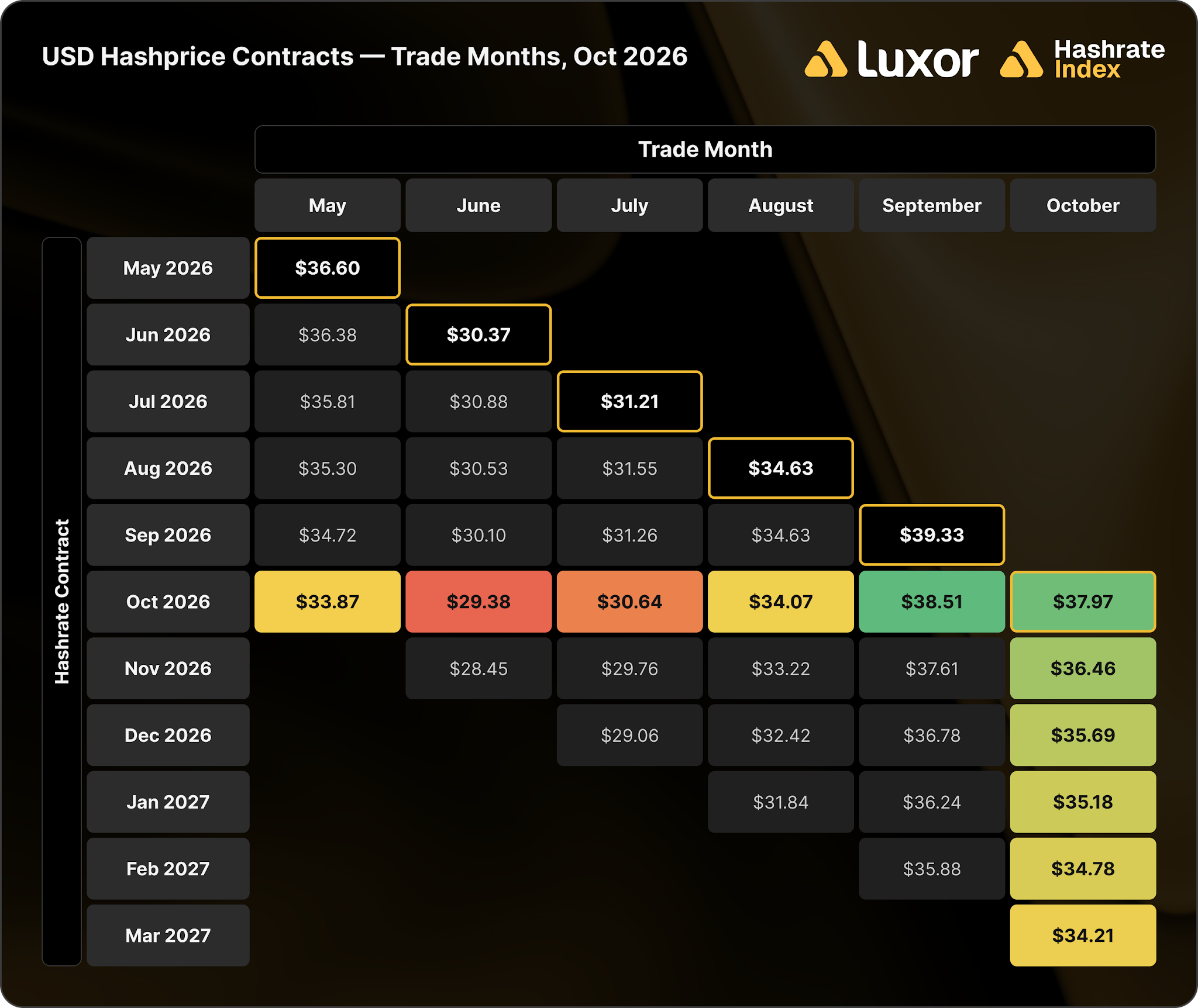
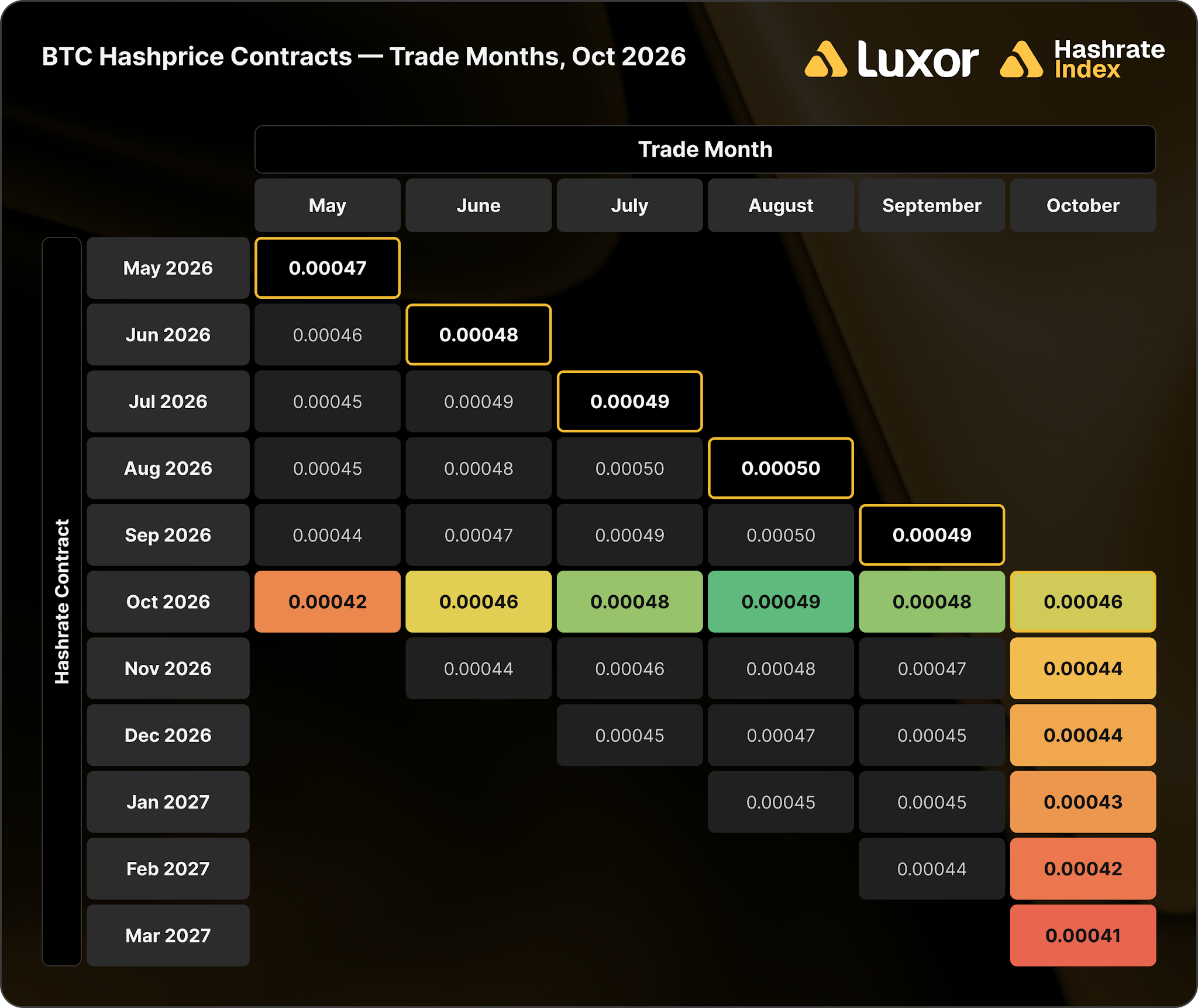
Note: all values (except for the bold highlighted main diagonal) shown in figures represent mid-market rates, the midpoint of the best bid and ask on Luxor's Non-Deliverable Hashrate Forward market. The bold highlighted main diagonal shows actual spot hashprice settlement in each month, measured by Luxor’s Bitcoin Hashprice Index.
The table below shows the type of market participants on the buy and sell side of Luxor’s deliverable (DF) and non-deliverable hashrate forward (NDF) market. In October, lenders were active on the buy side of the DF market, while public and private miners used the contract to sell forward, receive financing, and expand their fleet.
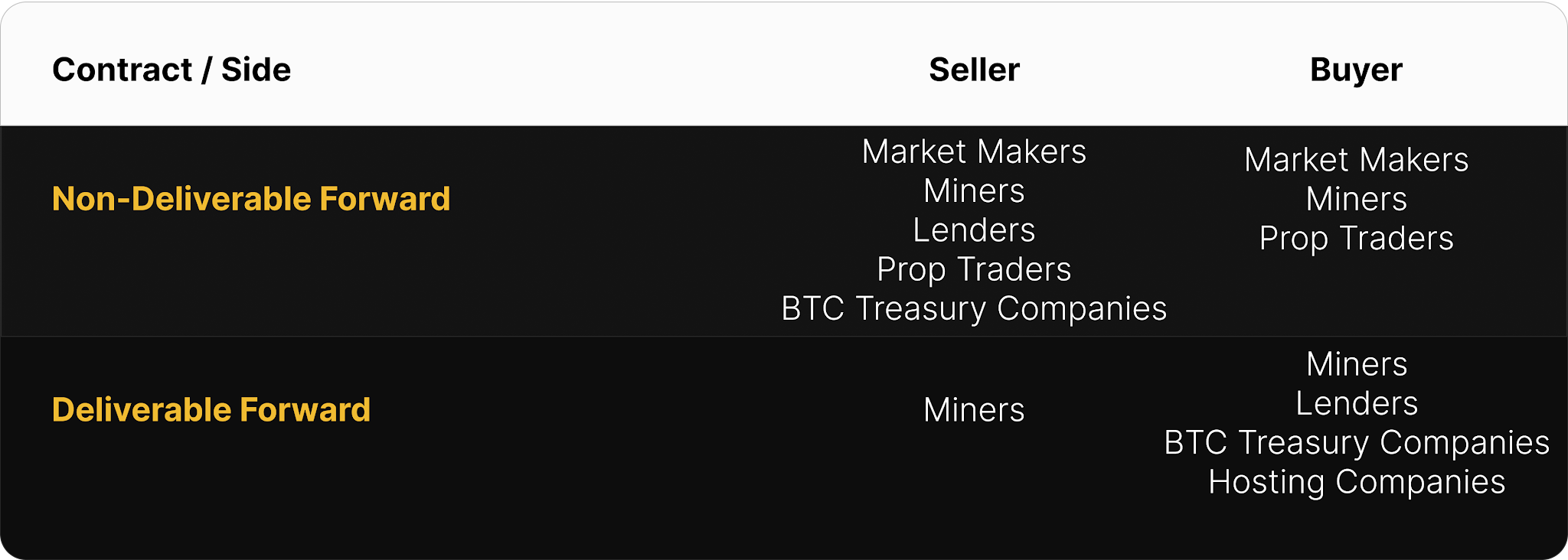
Because DFs are prepaid, they typically trade below NDFs to compensate buyers for credit risk and the cost of capital. Pairing a DF with an offsetting NDF can lock in that spread as a fixed BTC-denominated yield for lenders or a fixed financing cost for miners.
This strategy was used by lenders and Bitcoin treasury companies (buy DF & sell NDF) to earn a BTC-denominated return and by miners (sell DF & buy NDF) to obtain non-dilutive financing. In October 2026, that yield (cost of capital) was 6–13% annualized.
How October 2026 Hashrate Traded
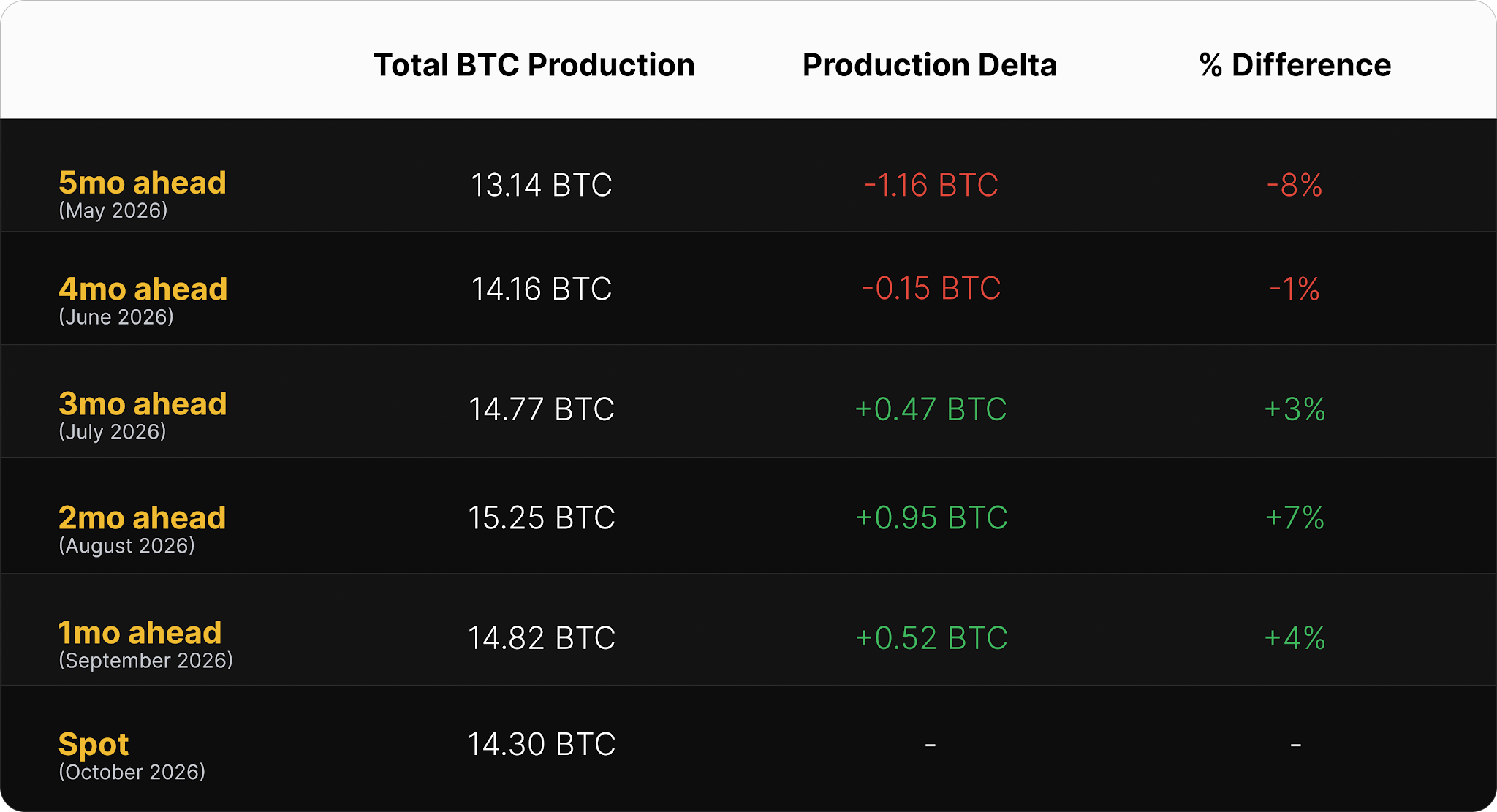
In USD terms, early sellers of the October contract lost and the latest seller won. Sellers of the October USD contract locked in between $29.38 and $38.51 per PH/s/day against a $37.97 spot settlement. Four of the five sales lost: the five-month sale from May gave up $4.10 per PH/s/day (−10.8%, or −$127,100 on 1 EH/s for the month) and the four-month sale from June gave up $8.59 (−22.6%). Only September's one-month sale, at $38.51, beat spot (+1.4%). It is the second consecutive month in which most USD hedges lost, and the fifth since the regime turned in late 2025.
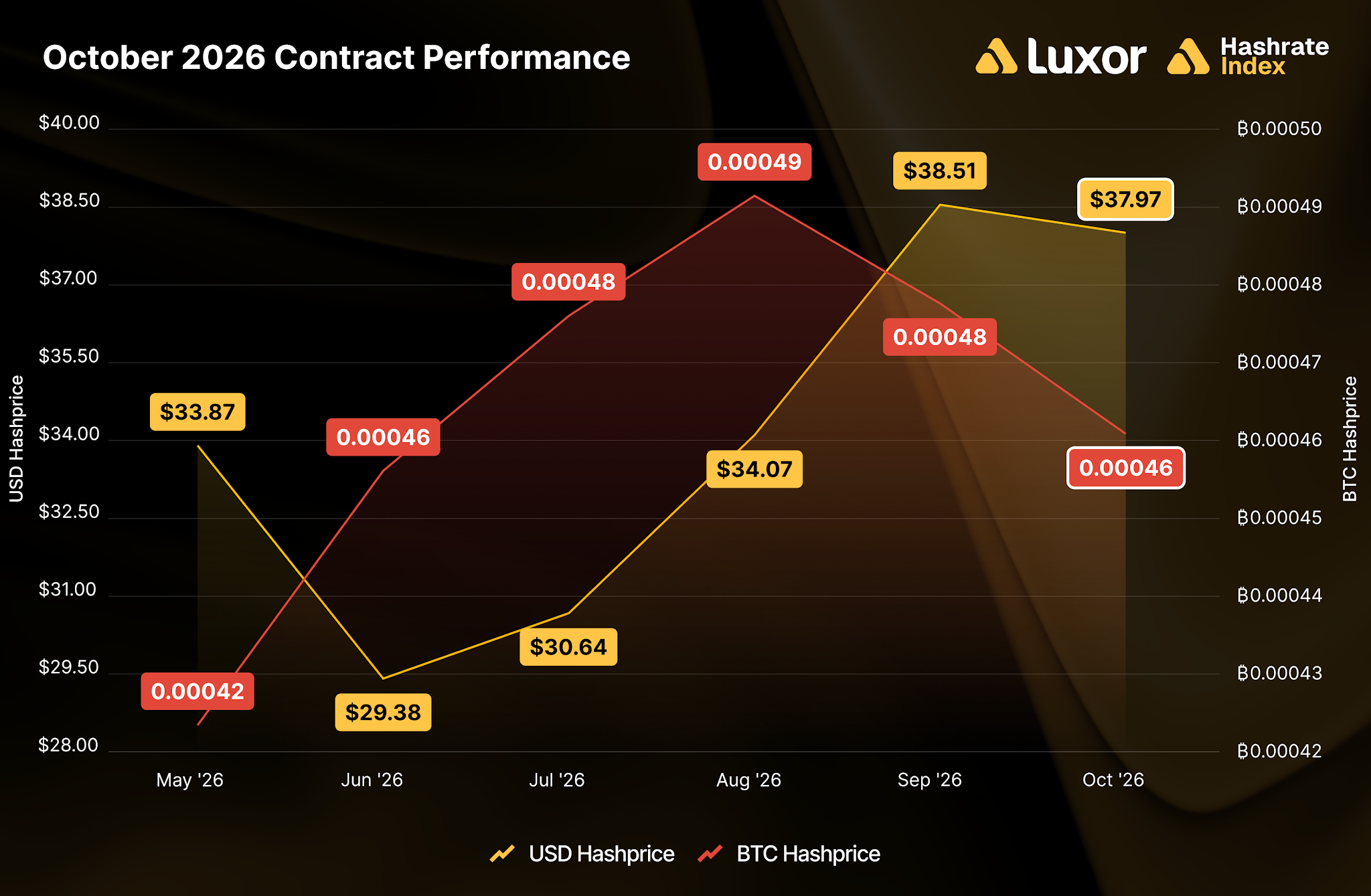
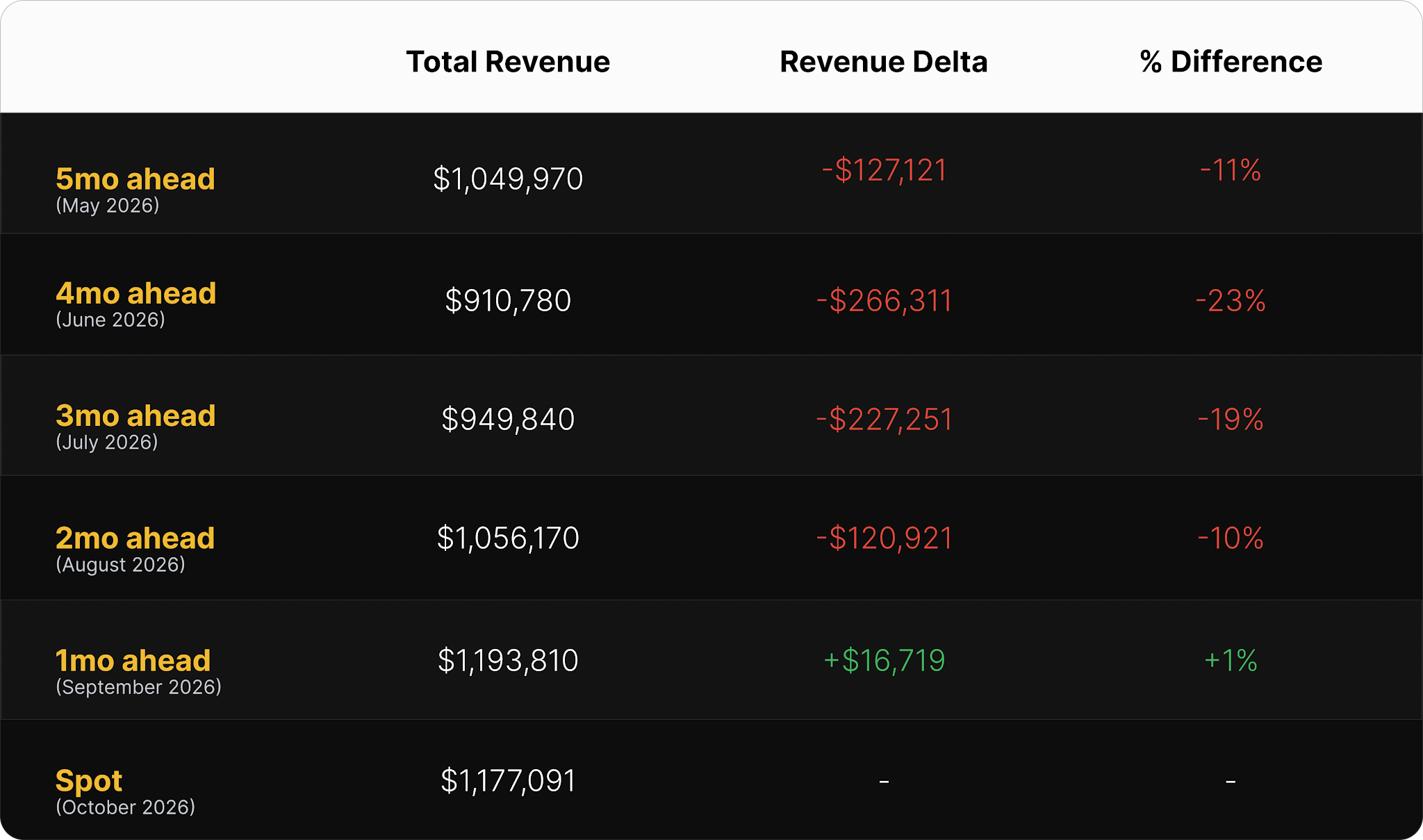
In BTC terms, the middle of the curve won. The sales two and three months out, at 0.00049 and 0.00048 BTC per PH/s/day, beat the 0.00046 BTC settlement by 6.6% and 3.3%, and September's one-month sale beat it by 3.6%. The five-month sale from May, at 0.00042 BTC, lost 8.1%; the four-month sale lost 1.0%. BTC-denominated hedges outperformed USD hedges for a second straight month.
Rolling Hedge Performance
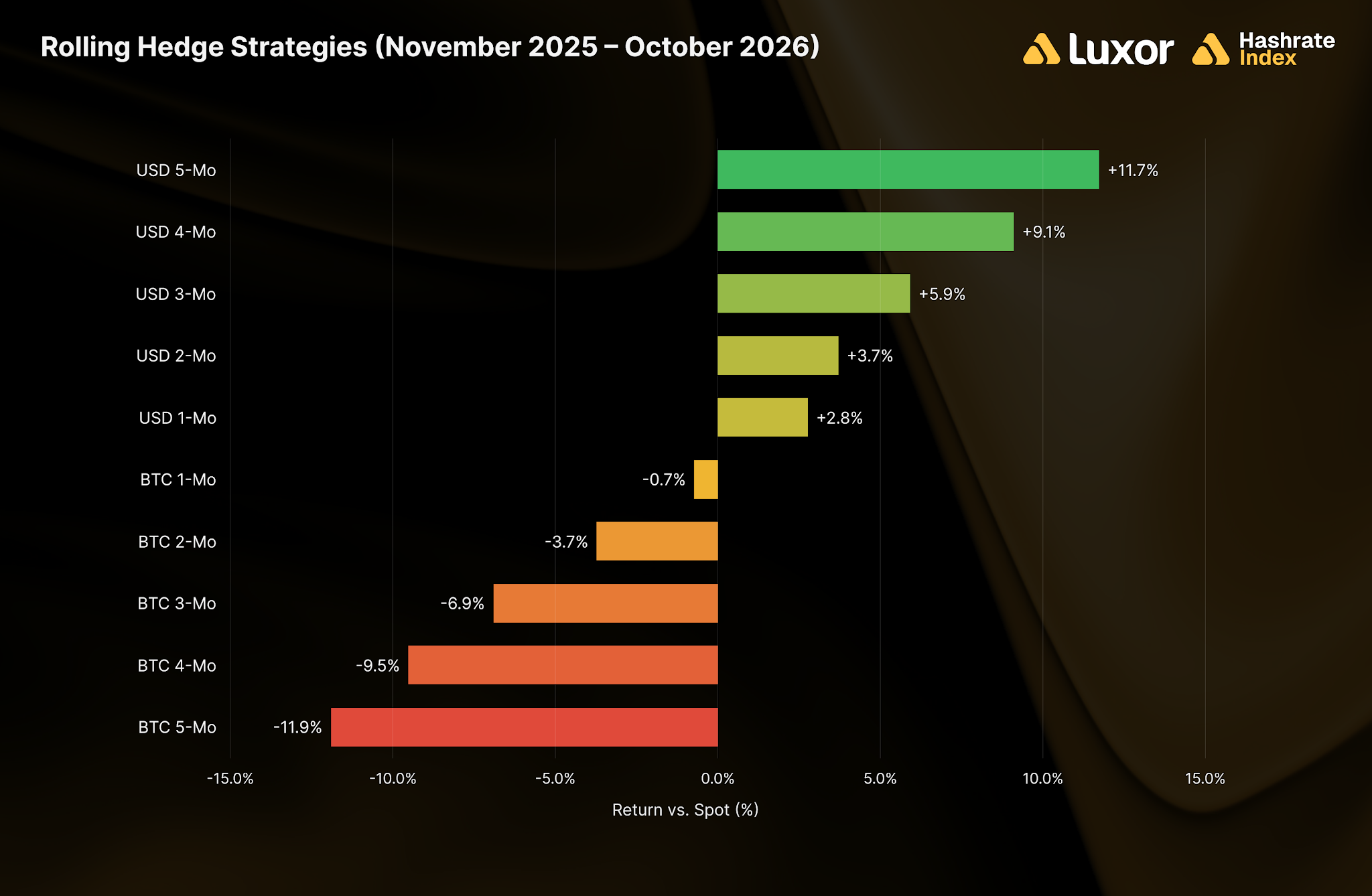
Across the trailing twelve months, rolling USD hashprice hedges beat spot mining (FPPS) at every horizon (+2.8% for 1-month to +11.7% for 5-month). Rolling BTC hashprice hedges lost at every horizon (−0.7% to −11.9%). October's settlement moved against both: the USD 5-month roll gave back 1.2 points from +12.9% a month ago as Bitcoin fell, and the BTC 5-month roll widened from −10.3% to −11.9% as difficulty rose.
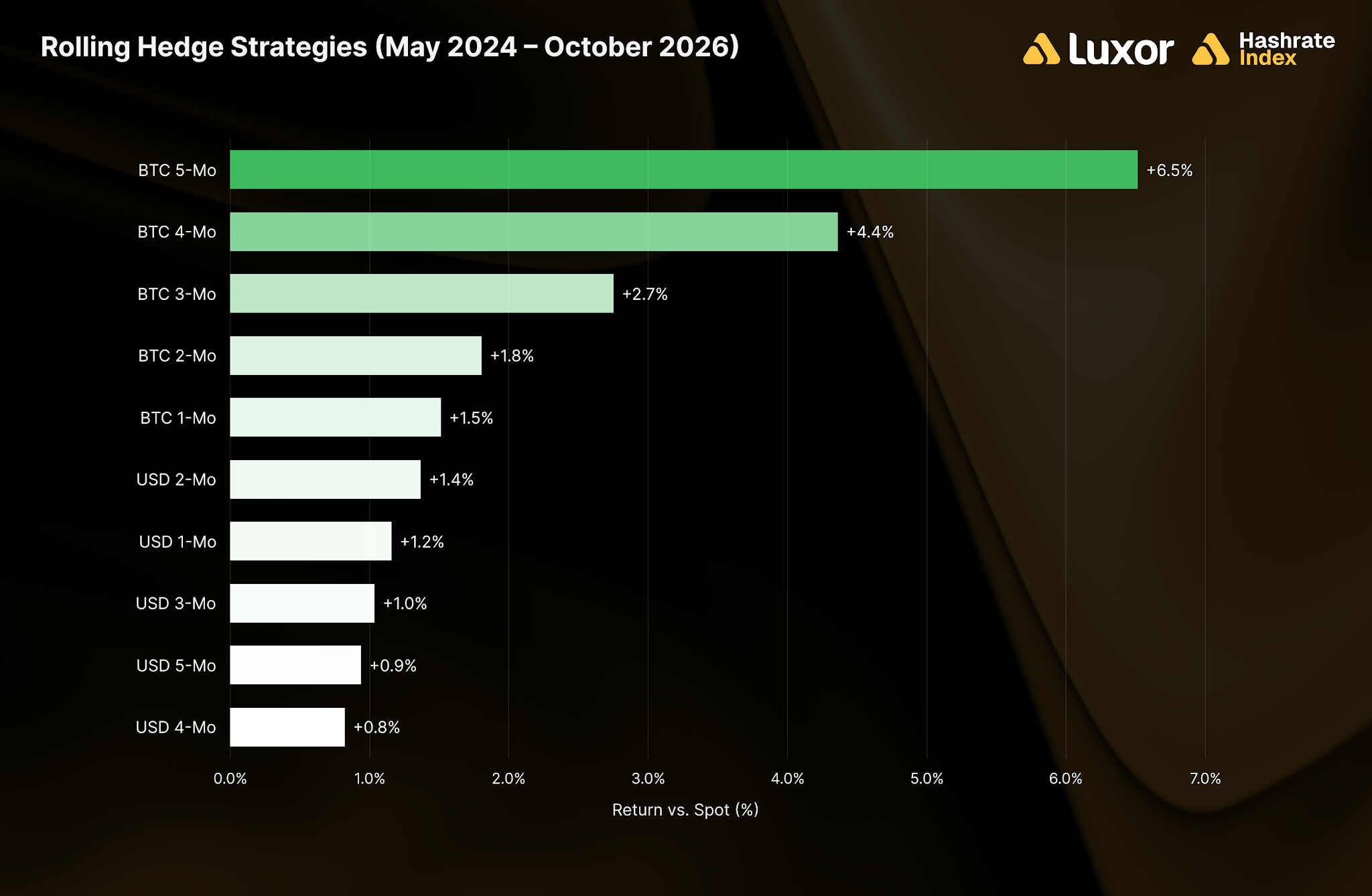
Since the 2024 halving, all ten strategies remain ahead of spot and BTC hashprice hedges still lead, with the 5-month roll at +6.5% against USD hedges between +0.8% and +1.4%. The BTC lead keeps narrowing: the 5-month roll stood at +6.9% a month ago and +12.5% in March, and October's five-month BTC sale, struck in May at the summer's lowest expectations, lost to spot.
Which hedge wins depends on what surprised the forward market. From the 2024 halving through late 2025, difficulty rose faster than the curve expected, so BTC-denominated sales paid. Since late 2025, Bitcoin's price has run below the curve, so USD-denominated sales paid instead. October was mixed. Bitcoin fell, but the USD contracts sold in May–August had priced a weaker summer than the one that arrived, so four of five still lost. In BTC terms, the 11.76% rise in difficulty was close to what the curve expected, and the mid-curve sales won. BTC hedges beat USD hedges for the second month running.
Note: figures exclude fees and bid/ask spreads, and hedging is a cost of business rather than a revenue generation strategy. Hedgers willingly buy the certainty of predictable cash flows, which increases valuations, reduces capital costs, and ultimately attracts investments.
How Future Hashrate Traded in October 2026
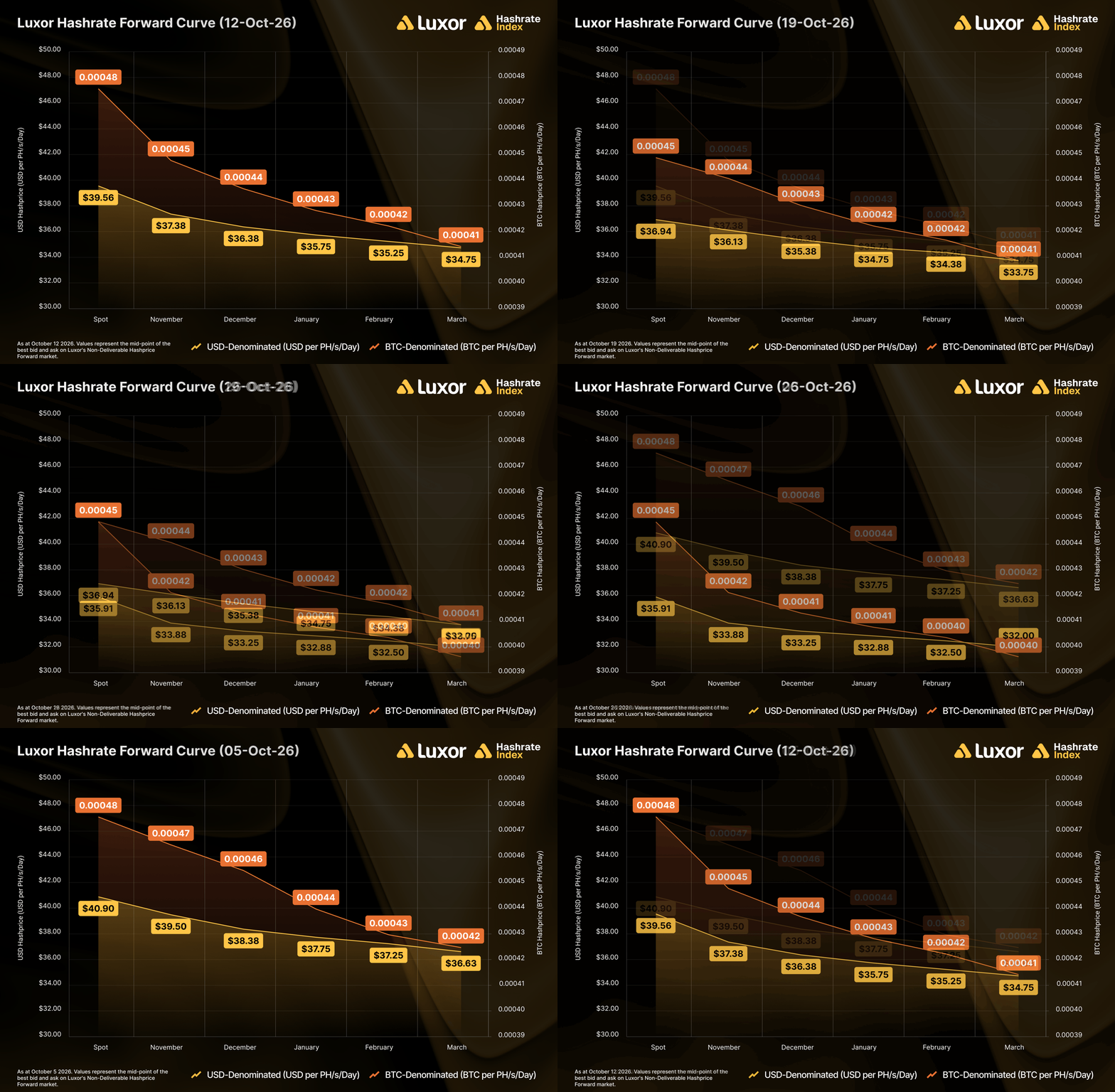
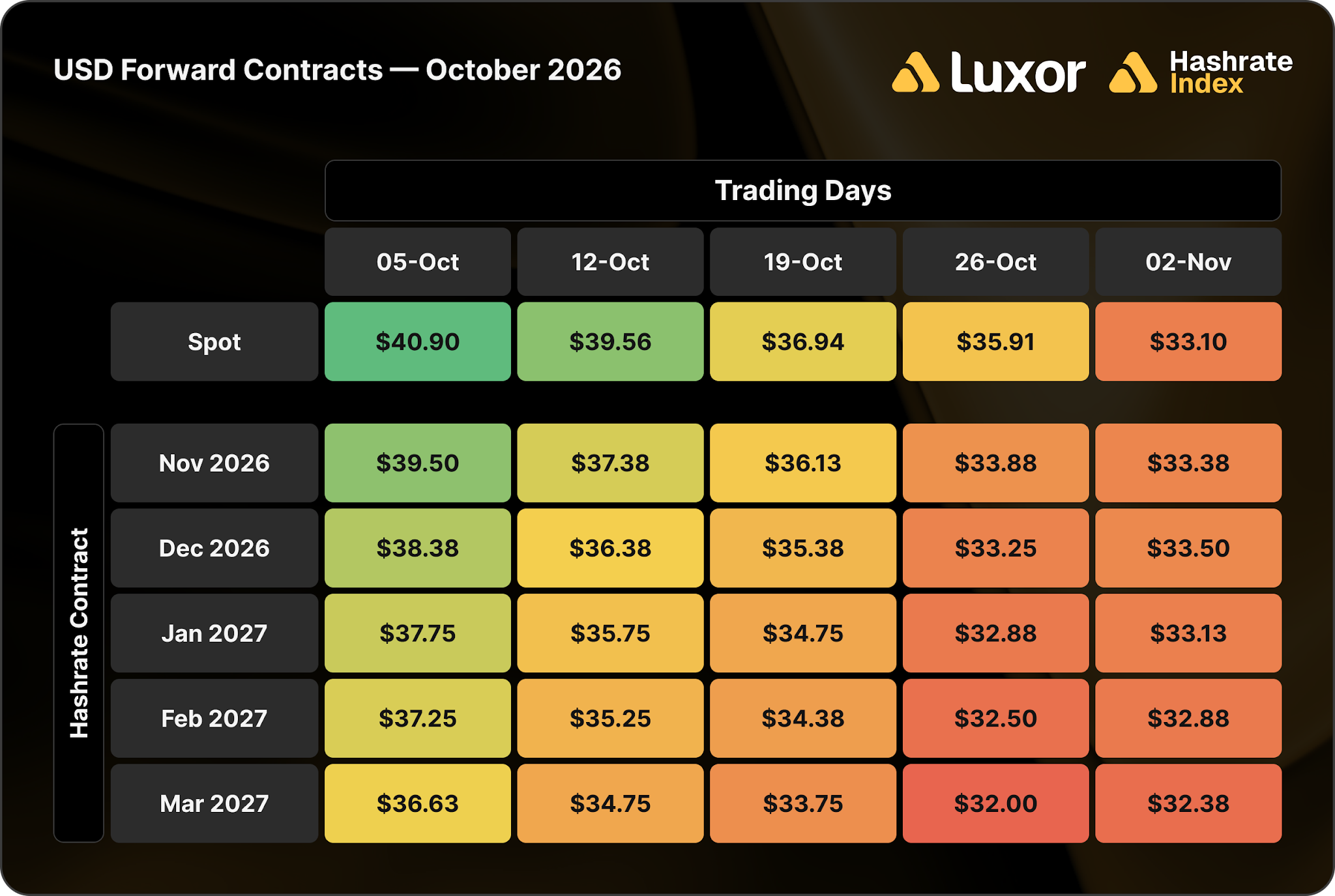
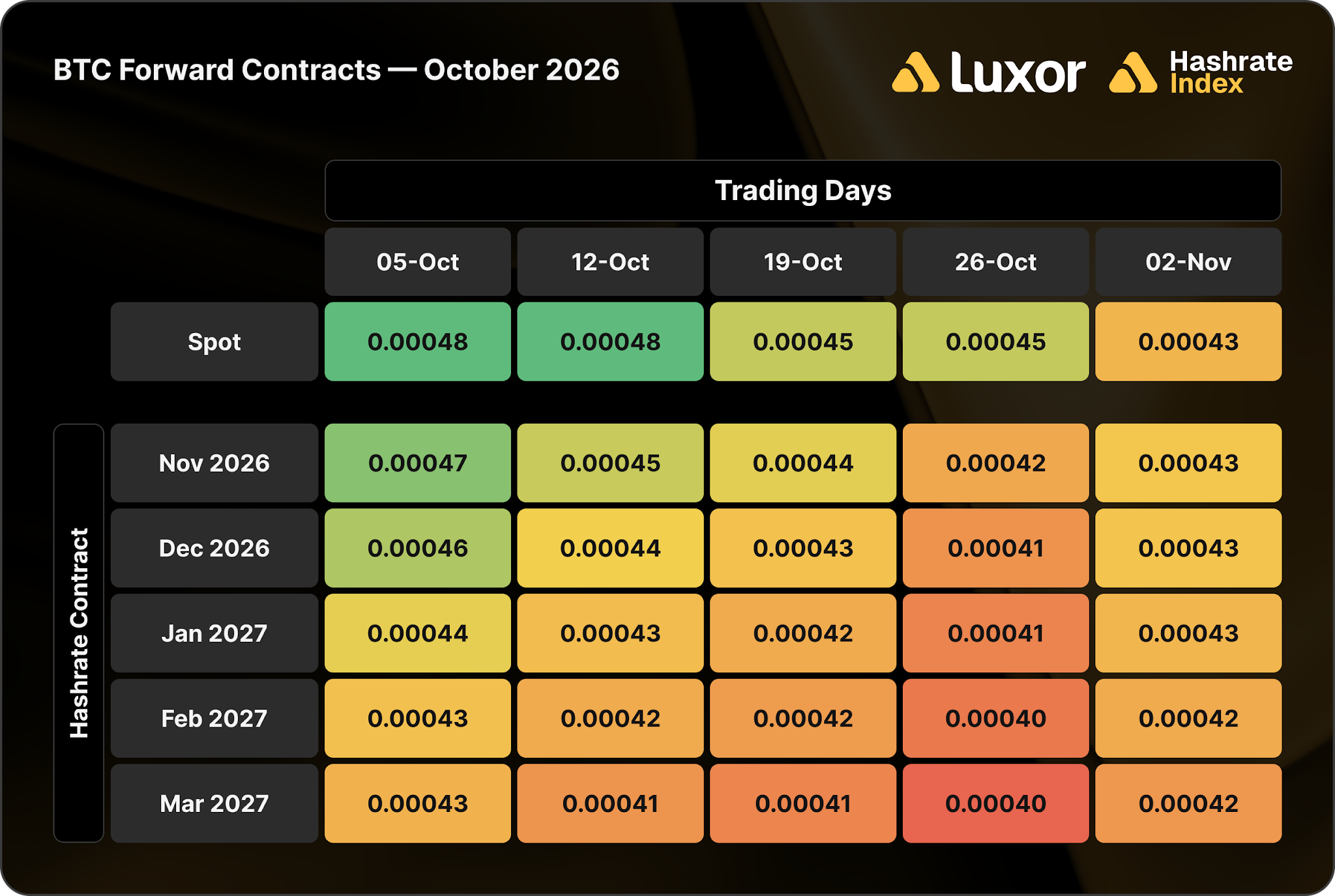
The tables below summarize the forward market during October 2026 for the five subsequent months, November 2026 to March 2027. Rows are monthly contracts; columns are weekly trading days. Cell values are the daily mid-market price, except for spot.
In October, the USD-denominated hashrate forward curve fell less than spot. Lock-in rates for November–March fell 11.6–15.5% between October 5 and November 2 against −19.1% in spot hashprice, with the front end of the curve moving most. The November 2 marks sit between $32.38 and $33.50 per PH/s/day, within a dollar of the $33.10 spot: the backwardation the curve carried into October has flattened out.
Over the same window, the BTC-denominated hashrate forward curve fell 1.7–7.0% across the strip against −10.5% in spot BTC hashprice. Read together, the forward market repriced two things at once: a lower Bitcoin price and a difficulty path that now runs flat to spot.
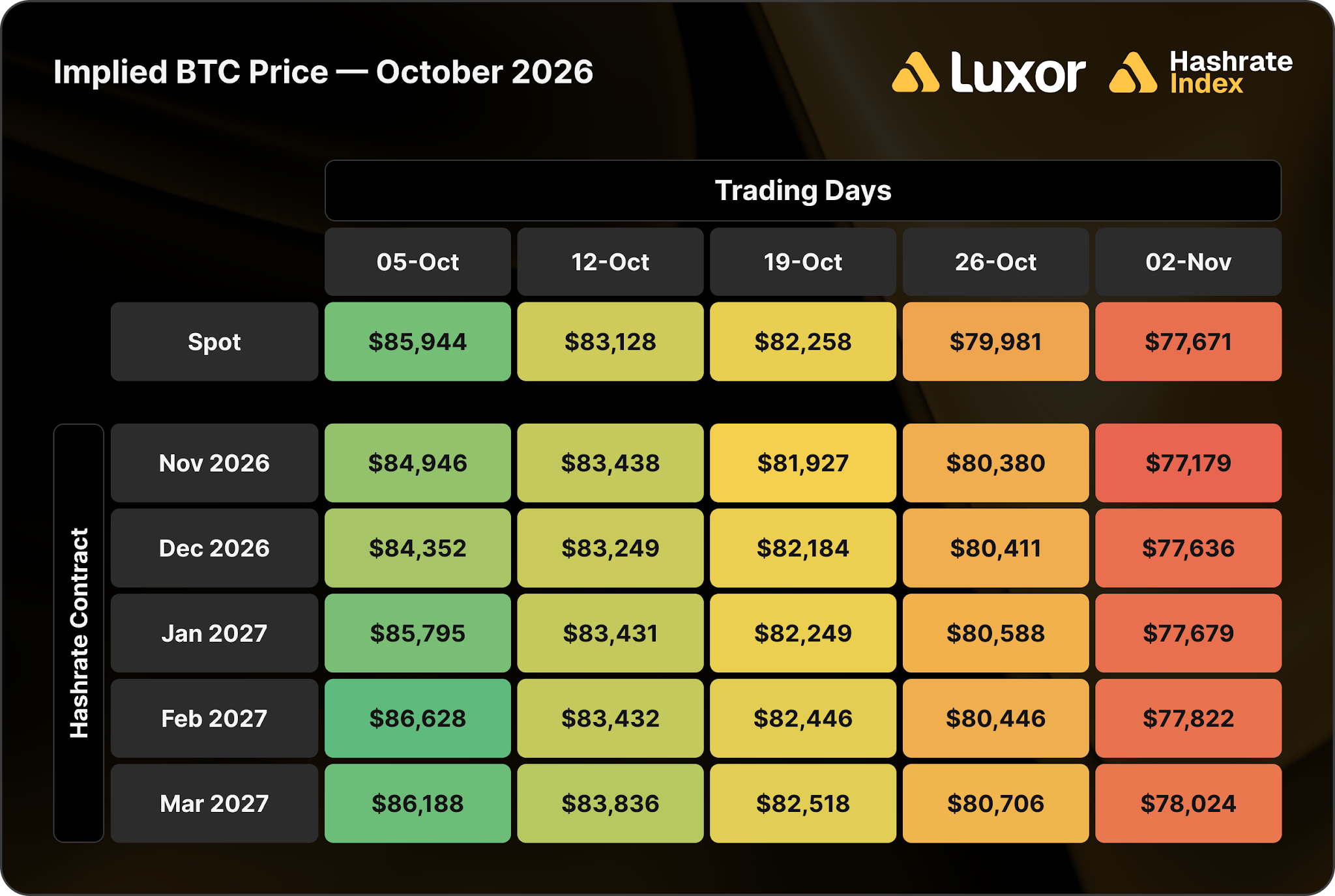
Dividing USD contract values by BTC contract values gives the implied BTC price embedded in the forward hashrate market. The November contract's implied BTC price moved from ~$84,900 to ~$77,200 (−9.1%), tracking spot. The curve sits at $77,200–$78,000 across all five months, a spread of about 1%: the market prices no Bitcoin recovery through March.
Assuming 0.0179 BTC per block in transaction fees (October's realized average), the same contracts imply the following forward-looking expectations on difficulty and network hashrate:
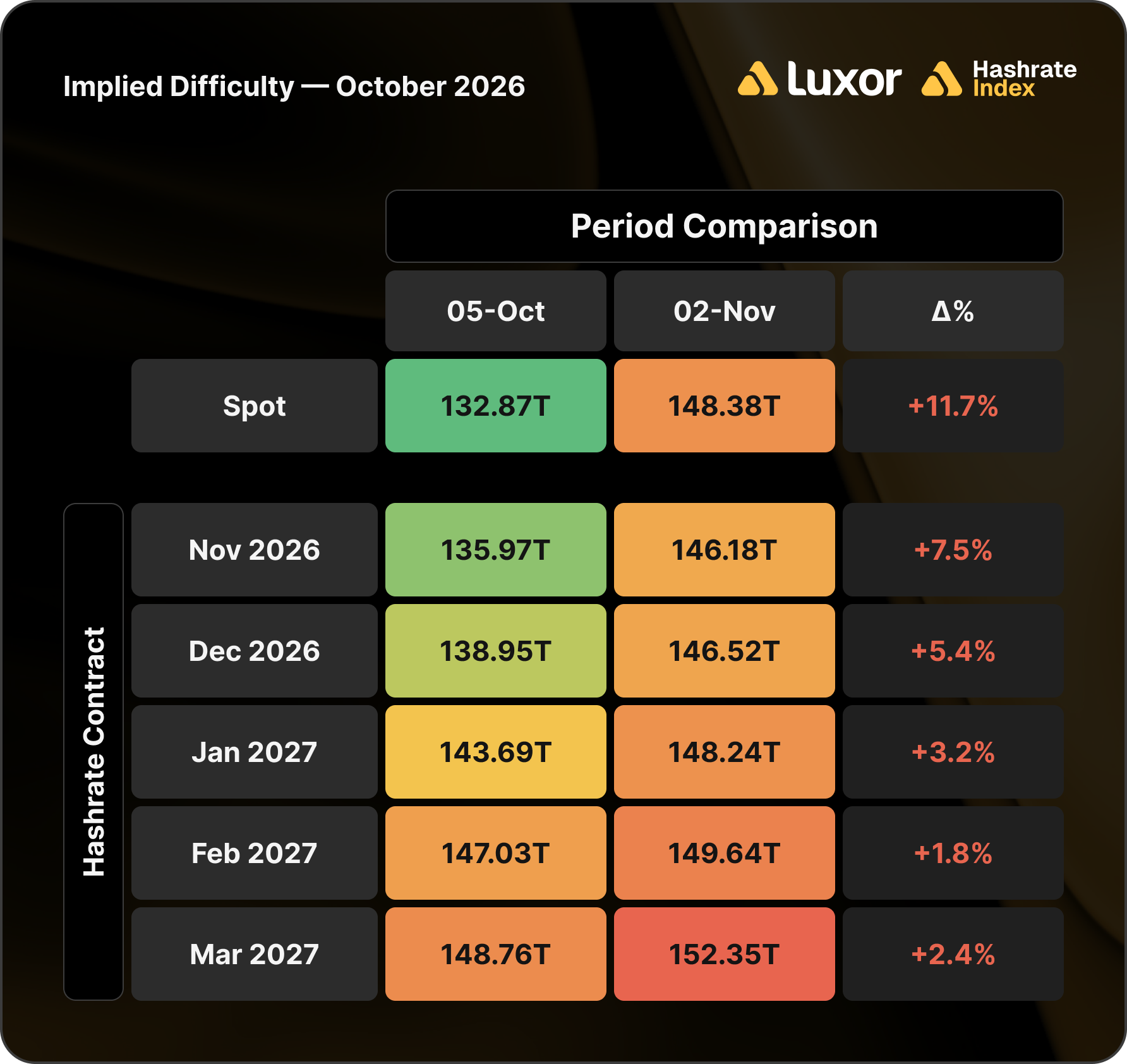
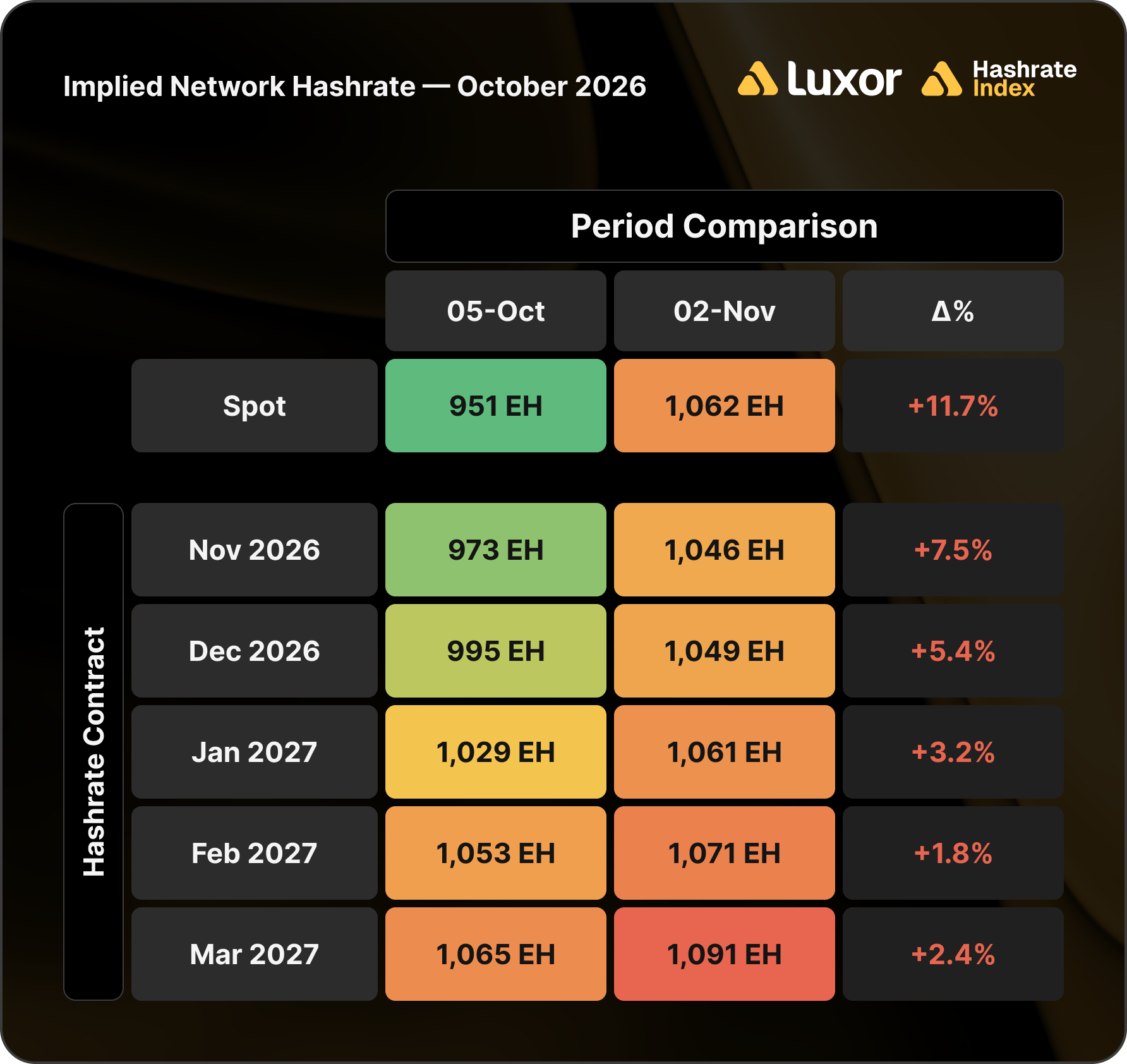
Note: figures assume 0.0179 BTC per block transaction fee collection.
The curve had already priced in the 4CP-driven return of hashrate. On October 26, before the month's third retarget, the November contract implied a difficulty of 150.00T against 140.81T spot. The October 29 retarget delivered 148.36T. By November 2, the November contract implied 146.18T, 1.5% below the 148.38T spot reading in that snapshot.
Beyond November the strip rises slowly, to 152.35T by March 2027 (+2.7% over spot). In hashrate terms, that is roughly 1,046 EH in November and 1,049 EH in December. The 1.5% gap is a small dip in November. The last time the curve priced a front-month dip, in July and August, 4CP curtailment made it happen. Nothing on the calendar does that now: a November dip would need miners to switch off on price or weather.
Concluding Thoughts and Looking Ahead
Through November 4, hashprice averaged $33.16 per PH/s/day (0.5% above October's $32.98 close) and Bitcoin $77,820. Bitcoin fell ~5% on November 5 to ~$76,250, which puts spot hashprice near $32.75 per PH/s/day.
What Comes Next?
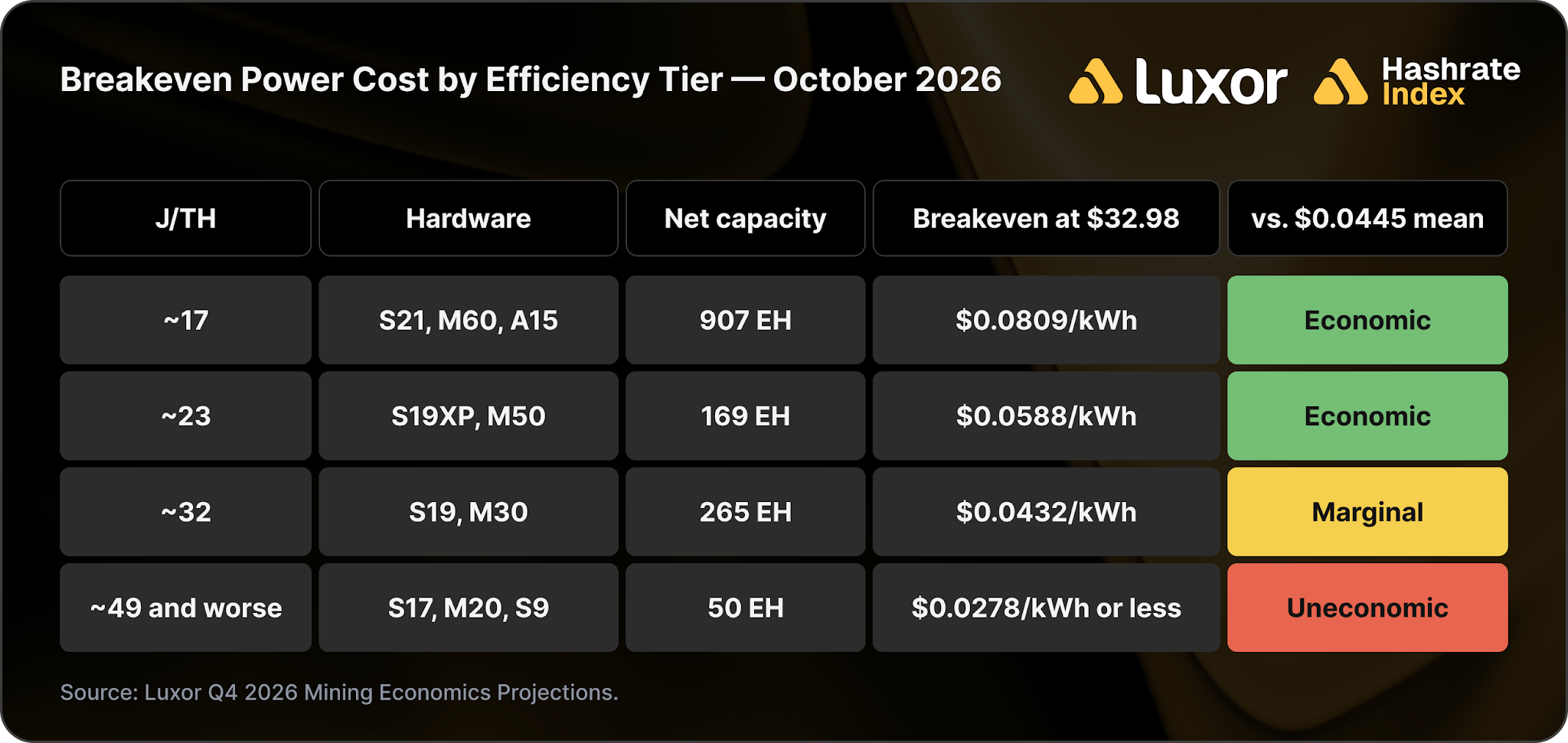
Curtailed hashrate is back; the question is what is left to come. Luxor's Q4 2026 Mining Economics Projections put net ASIC capacity at ~1,390 EH for October against 1,067 EH of active hashrate at month-end, leaving ~323 EH idle, close to the model's three least-efficient tiers combined (~32 J/TH and worse, 314 EH). The Base case projected 1,024 EH of equilibrium hashrate for October; the network averaged 1,026 EH. . At $32.98 per PH/s/day, the model's ~32 J/TH tier breaks even at $0.0432/kWh, and the ~49 J/TH tier needs $0.0278/kWh or less to run. The marginal fleet is priced out rather than curtailed.
This summer's curtailment ran on a schedule: 4CP. Winter curtailment does not. In Texas it is triggered by weather events and price spikes, and it takes efficient and inefficient fleets offline alike, for hours rather than weeks. A hashprice-driven exit is different: it starts with the least efficient fleets wherever they sit, and the Texas hashrate that came back in October skews newer than the network average. October's average network hashrate ran 11.3% above the June–September average, in line with 2024 (+11.2%) and short of 2025 (+15.6%). The step up from September alone was +8.8%, the largest of the three years (+6.3% in 2024, +5.6% in 2025): the summer of 2026 had more hashrate waiting to come back.
BTC Price
Bitcoin ended October 37.9% below its October 6, 2025 peak, 390 days after setting it. At the same point in the prior two cycles, Bitcoin sat 81.3% below the December 2017 peak and 74.8% below the November 2021 peak; this cycle's deepest drawdown so far is 52.6%, at the June 30 low. The three scenarios below are the Bear, Base and Bull cases from Luxor's Q4 2026 Mining Economics Projections, quoted at March 2027, the far end of the forward curve.
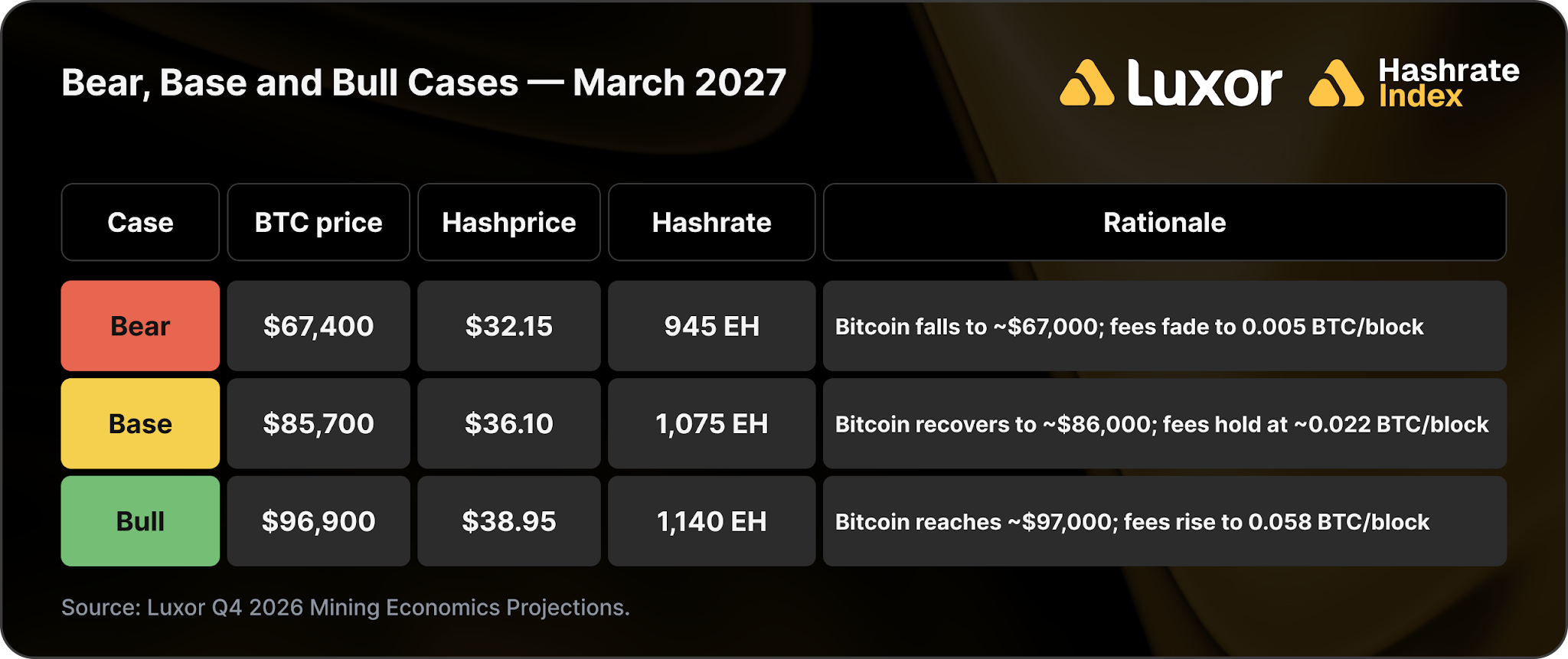
These are equilibrium figures, so they understate the swing. In the Bear case, Bitcoin's drop would push hashprice toward $29 first; the network then sheds ~120 EH by March, difficulty follows it down, and hashprice settles near $32. In the Bull case, Bitcoin near $97,000 would lift hashprice above $41 at today's 1,067 EH; ~73 EH of new hashrate then brings it back to $39, costing miners ~$2.65 per PH/s/day. The Base case holds hashprice near $36 with the network roughly where it is now.
At $77,000 and 148.36T, hashprice is $33 per PH/s/day. Each further +5% retarget takes ~$1.60 off that at a flat Bitcoin price; each $5,000 move in Bitcoin shifts it ~$2.15. At October's block pace the next retarget lands around November 11. The grid below shows hashprice per PH/s/day across Bitcoin price and difficulty, with fees held at October's 0.0179 BTC per block.
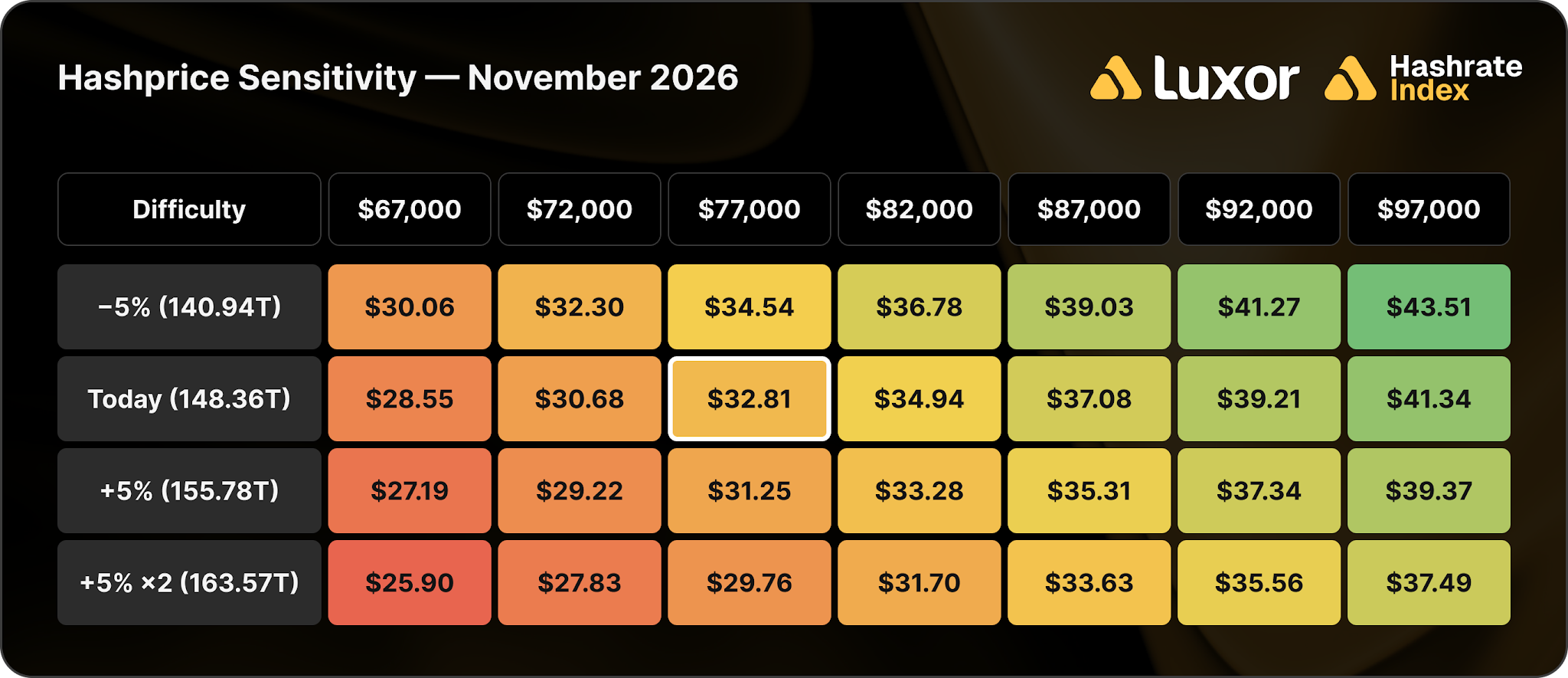
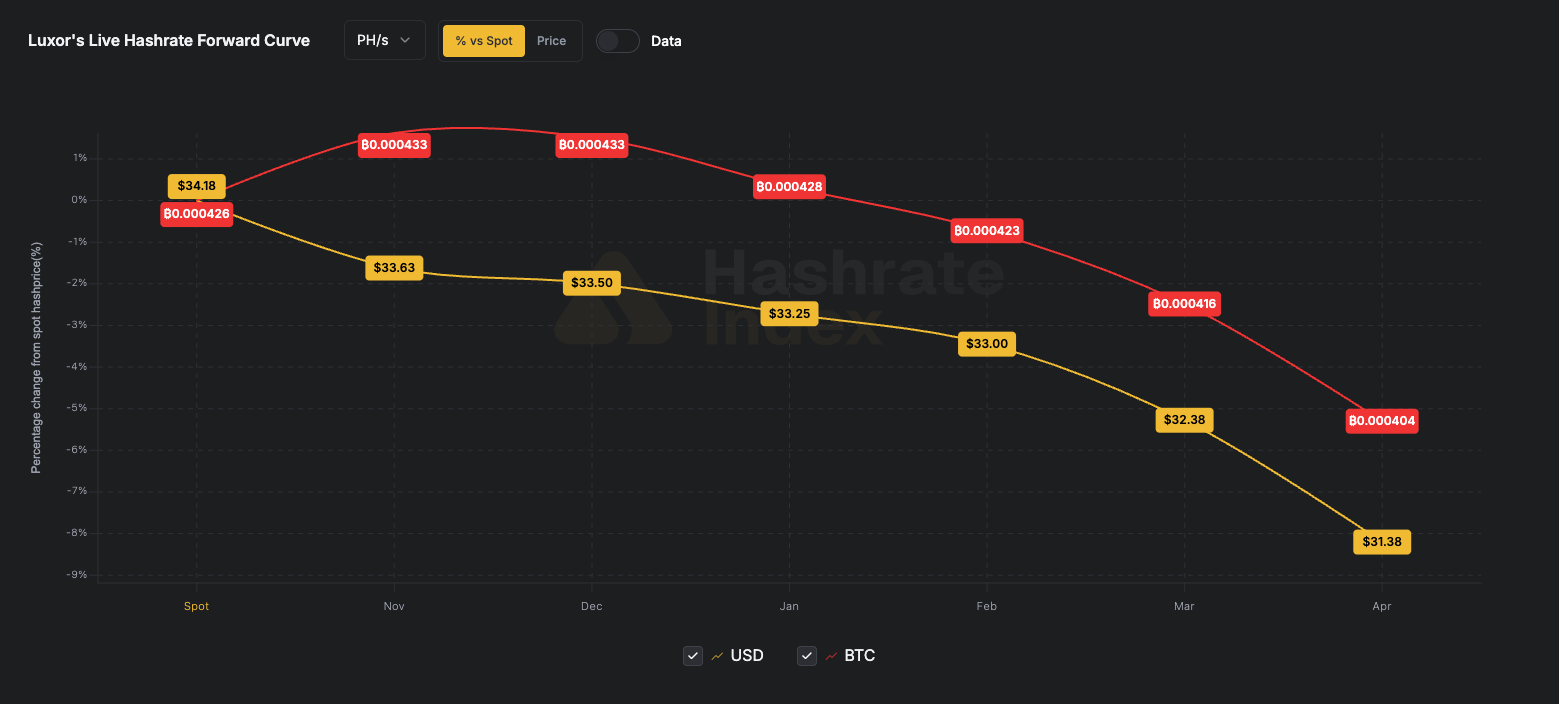
The forward curve puts the answer at flat: $32–34 and 0.00042–0.00043 BTC per PH/s/day through March, with difficulty within 3% of today's. For a $40 hashprice to return, Bitcoin needs ~$94,000 at current difficulty, or difficulty has to fall, and the only thing that reliably pulls difficulty down from here is weather.
Looking Ahead
Luxor's Hashrate Forward Market is currently pricing an average hashprice of $32.86 or 0.00042 BTC per PH/s/day over the November 2026 – April 2027 window. Against today's post-drop spot hashprice, the USD curve sits 3.5% above spot in November and 3.4% below by April. In BTC it runs 1.6% above spot in November and 5.4% below by April.
If you’d like to learn more about Luxor’s Bitcoin mining derivatives, please reach out to [email protected] or visit https://www.luxor.tech/derivatives.
About Luxor Technology Corporation
Luxor delivers hardware, software, and financial services that power the global compute and energy industry. Its product suite spans Bitcoin Mining Pools, ASIC Firmware, Hardware trading, Hashrate Derivatives, Energy services, a Miner Management software, Commander, and a bitcoin mining data platform, Hashrate Index.
Disclaimer
This content is for informational purposes only, you should not construe any such information or other material as legal, investment, financial, or other advice. Nothing contained in our content constitutes a solicitation, recommendation, endorsement, or offer by Luxor or any of Luxor’s employees to buy or sell any derivatives or other financial instruments in this or in any other jurisdiction in which such solicitation or offer would be unlawful under the derivatives laws of such jurisdiction.
There are risks associated with trading derivatives. Trading in derivatives involves risk of loss, loss of principal is possible.




Hashrate Index Newsletter
Join the newsletter to receive the latest updates in your inbox.